English
 عربى
عربى BLDC
BLDC

Content
- 1 Why Aluminium Is the Standard Material for Solar Brackets
- 2 Aluminium Alloy Grades Used in Solar Mounting Brackets
- 3 Types of Aluminium Solar Brackets by Mounting Application
- 4 Key Components of an Aluminium Solar Bracket System
- 5
- 6 How to Choose the Right Aluminium Solar Bracket for Your Installation
- 7 Common Installation Mistakes and How to Avoid Them
- 8 Maintenance and Lifespan of Aluminium Solar Mounting Brackets
- 9 Aluminium Solar Brackets for Specialist Applications
Why Aluminium Is the Standard Material for Solar Brackets
Walk up to almost any rooftop solar installation and the mounting hardware holding those panels in place will almost certainly be aluminium. That's not a coincidence. Aluminium solar brackets offer a combination of properties that no other common material matches for this application: low density, natural corrosion resistance, high structural strength relative to weight, and excellent compatibility with the aluminium frames already used on most solar panels.
The density of aluminium sits at around 2.7 g/cm³ — roughly one third that of steel. For rooftop systems, that weight difference matters. Lighter brackets reduce the additional structural load placed on a building and cut transportation and handling costs significantly. One product-line comparison found that switching from heavier framing to 6005-T5 aluminium alloy brackets delivered a 30% reduction in bracket weight while maintaining full structural integrity under rated loads.
Beyond weight, aluminium forms a thin, stable oxide layer on its surface when exposed to air, which protects the underlying metal from further corrosion without any additional coating. When that natural resistance is further enhanced through anodising — an electrochemical process that thickens and hardens the oxide layer — aluminium solar mounting brackets become highly resistant to rain, UV radiation, humidity, and even the salt-laden air found in coastal environments.
Aluminium Alloy Grades Used in Solar Mounting Brackets
Not all aluminium is the same. The mechanical properties of an aluminium solar bracket depend heavily on the specific alloy and heat treatment used in its manufacture. Three grades dominate the solar mounting industry, each with a distinct balance of strength, formability, and corrosion resistance.
6005-T5: The Industry Standard for Extruded Brackets
Aluminium alloy 6005-T5 is the most widely specified grade for solar mounting rails, bracket profiles, and structural components globally. It belongs to the 6000 series (aluminium-magnesium-silicon), which offers an optimal balance of extrudability, corrosion resistance, and mechanical strength. The T5 temper designation means the alloy has been artificially aged after the extrusion process, resulting in a minimum tensile strength of approximately 260 MPa and a yield strength of 240 MPa. The closely related 6005A variant adds chromium and manganese to improve toughness and further reduce stress corrosion susceptibility, making it a preferred choice in demanding environments.
6061-T6: Higher Strength for Structural Applications
For installations where spans between attachment points are longer, or where structural loads are particularly demanding, 6061-T6 aluminium is commonly specified. With a minimum tensile strength of 310 MPa and yield strength of 276 MPa, 6061-T6 delivers higher structural capacity than 6005A-T5 at the same cross-sectional dimensions. This allows installers to space roof attachments further apart — a meaningful advantage when rafter positions constrain mounting layout. The trade-off is that 6061-T6 extrudes less easily into complex cross-section profiles than 6005, which limits its use to simpler bracket shapes.
6063-T5: Lightweight and Architectural
6063 aluminium is widely used in architectural extrusions and window framing. In solar applications, it appears in lighter-duty components and brackets for smaller residential arrays where brute structural capacity is less critical than formability and surface finish quality. Its corrosion resistance is excellent, but its mechanical strength is lower than both 6005 and 6061, which limits its use to applications with moderate load requirements.
| Alloy Grade | Tensile Strength | Yield Strength | Best For | Anodising Quality |
|---|---|---|---|---|
| 6005-T5 | ~260 MPa | ~240 MPa | Rails, standard brackets, most rooftop systems | Excellent |
| 6061-T6 | ~310 MPa | ~276 MPa | Long-span structures, demanding load environments | Good |
| 6063-T5 | ~185 MPa | ~145 MPa | Light residential systems, architectural components | Very Good |
Types of Aluminium Solar Brackets by Mounting Application
The right type of aluminium solar bracket depends on where the panels are being installed and what surface they're attaching to. Each bracket category is engineered around the specific structural and waterproofing challenges of its target application.
Sloped Roof Brackets (Pitched Roof Systems)
Sloped roof installations are the most common residential scenario. The aluminium mounting system typically consists of roof hooks or L-foot brackets anchored into the rafters, aluminium rails running parallel to the roof surface, and clamps that grip the panel frames to the rails. Tile roof hooks are specially shaped to slide under individual tiles without cracking them, keeping the water plane intact. For metal roofs — whether standing seam, corrugated, or trapezoidal — dedicated clamps or hanger bolts attach to the roof ribs, often using EPDM rubber washers to create a watertight seal around any penetrations. A key installation rule: always anchor to the structural members (rafters, purlins) underneath the roof cladding, never to the cladding alone.
Flat Roof Tilt Brackets
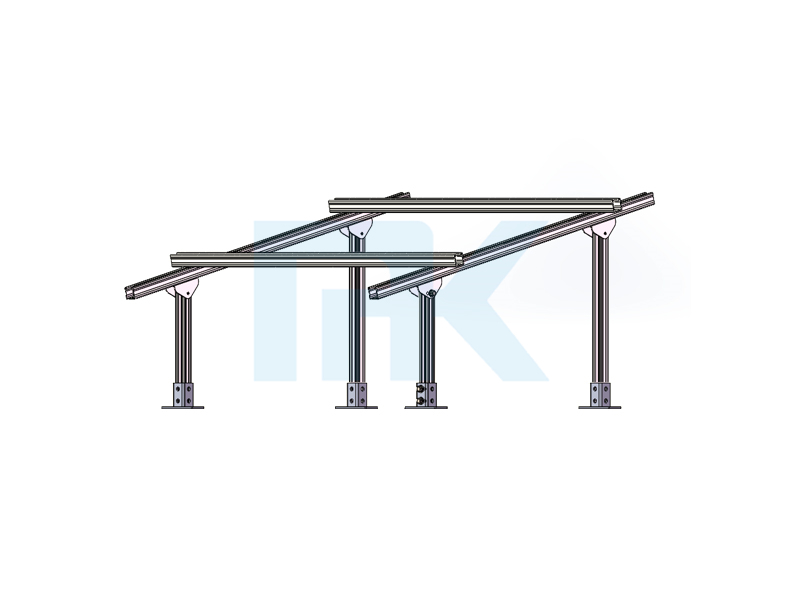
Flat roofs require aluminium tilt brackets to elevate one edge of each solar panel and create an optimal angle for sun exposure — typically between 10° and 30°, depending on latitude. These brackets either penetrate the roof membrane and anchor to the structural deck, or they use ballast (concrete blocks or pavers) to hold the frame in place without drilling. Ballasted systems are popular on waterproofed flat roofs because they eliminate the risk of penetration leaks, but they require a careful load calculation to ensure the roof structure can handle the combined weight of ballast, brackets, and panels. Adjustable aluminium tilt legs allow the angle to be tuned for seasonal sun differences or to compensate for partial shading from nearby objects.
Ground Mount Aluminium Brackets
Ground-mounted aluminium solar racking systems are used where roof space is limited or where large-scale arrays need to be built on open land. These systems use deep-driven galvanised steel or aluminium piles or screw anchors as foundations, with aluminium cross-rails and table-frame structures carrying the panels above. Ground mounting allows for unrestricted tilt angle optimisation and easier maintenance access. For large commercial or utility installations, the rails are engineered as continuous beams with carefully spaced support posts to handle wind uplift and snow loading without deflection.
Wall-Mounted and BIPV Brackets
Building-integrated photovoltaic (BIPV) systems mount solar panels on vertical facades, replacing conventional cladding. Wall-mounted aluminium brackets for these applications must handle both the wind pressure pushing against the face of the panels and the suction force pulling them away from the wall. They are commonly used on commercial buildings with limited roof space, where the solar array doubles as architectural cladding. The aluminium profiles used in these systems are often custom-extruded to match the building's design requirements.
Carport and Pergola Brackets
Carport solar brackets are a growing application that combines vehicle shade coverage with power generation. Aluminium is the dominant material for these structures because its light weight reduces the span requirements of the supporting posts, keeping construction costs down. The panels are typically mounted flat or at a shallow tilt on aluminium purlins spanning between the carport rafters. Residential pergola solar systems use similar aluminium bracket hardware at a smaller scale to integrate panels into garden or terrace structures.
Key Components of an Aluminium Solar Bracket System
A complete aluminium solar mounting system is made up of several individual components, each with a specific structural role. Understanding these parts helps you evaluate product quality and ask the right questions before purchasing.
- Roof hooks / L-feet: The primary anchor point between the aluminium rail and the roof structure. For tile roofs, hooks slip under individual tiles and bolt to the rafter. For metal roofs, L-feet bolt directly to the rib or purlin using stainless steel fasteners. Quality hooks include EPDM rubber gaskets to seal around any fastener penetrations.
- Mounting rails: Extruded aluminium channels — typically 6005-T5 or 6061-T6 — that run across the roof and carry the panel clamps. Rail profile depth and wall thickness determine the maximum unsupported span. Most standard residential rails support spans of 800 mm to 1,200 mm between attachment points.
- Mid clamps and end clamps: Aluminium clamps that grip the panel frame to the rail. Mid clamps secure the gap between two adjacent panels; end clamps secure the outermost edge of the array. Clamp height must match the thickness of the panel frame — typically 30 mm to 50 mm for most modern panels.
- Rail splices and connectors: Aluminium or stainless steel splice pieces that join two lengths of rail end-to-end, maintaining structural continuity across the entire row. Poorly designed or under-torqued rail splices are a common cause of long-row rail deflection under wind loading.
- T-bolts and fasteners: Stainless steel (SUS304 grade) T-bolts slide into the slot of the aluminium rail and accept the clamp assembly. Using stainless hardware with aluminium rails is essential to prevent galvanic corrosion at the contact point.
- Grounding lugs: Aluminium or stainless grounding clips that bond the panel frames electrically to the rail, providing a continuous earth path through the array without requiring separate grounding wires on each panel.
How to Choose the Right Aluminium Solar Bracket for Your Installation
Selecting aluminium solar panel mounting brackets isn't a one-size-fits-all decision. Several site-specific factors determine which bracket type, alloy grade, and configuration will perform reliably over the 25-year lifespan of a typical solar panel system.
Match the Bracket Type to Your Roof Material
Tile roofs need hooks specifically shaped for the tile profile — flat concrete tiles require a different hook geometry than curved clay or slate tiles. Metal roofs with standing seams can use non-penetrative seam clamps; corrugated roofs generally need L-feet hanger bolts through the crest of each corrugation (never the valley, where water flows). Flat roofs benefit from ballasted tilt systems when the waterproofing membrane is new or recently installed. Matching the bracket hardware to your roof type from the start avoids expensive rework and preserves roof warranties.
Calculate Wind and Snow Loads Before Specifying
Aluminium solar brackets are structural components and must be rated for the environmental loads at your specific site. Wind uplift is typically the governing load for roof-mounted systems — roof edges and corners experience significantly higher uplift forces than central areas. Coastal, hilltop, and high-altitude sites often require closer rafter attachment spacing or heavier-gauge rail profiles to stay within the allowable deflection limits. Snow loading is the primary concern in colder climates, where accumulated snow can add over 1.4 kN/m² to the panel and bracket structure.
Verify Alloy Grade and Surface Treatment
For most residential and commercial rooftop systems, 6005-T5 anodised aluminium brackets represent the practical optimum — strong enough for standard spans, lightweight, and corrosion-resistant without premium pricing. For coastal environments where salt spray is a daily reality, confirm that the brackets carry an anodised or powder-coated finish with a minimum anodising layer thickness of 15–20 microns. Avoid brackets with unspecified alloy grades or visible bare aluminium at cut ends, as these indicate lower manufacturing standards.
Check Compatibility with Your Panel Frame Dimensions
Panel frame thickness varies between manufacturers and models, typically ranging from 30 mm to 50 mm. End and mid clamps must match this thickness range. Some clamp systems are adjustable across a range of frame heights; others are fixed to a single size. Confirm compatibility before purchasing, especially if you're working with oversized commercial panels or thin-frame residential modules.
Look for Relevant Certifications
Quality aluminium solar mounting systems carry independent test certifications that verify structural and electrical performance. The most relevant standards include UL 2703 (North American market), MCS 012 (UK), and compliance with structural codes such as AS/NZS 1170.2, Eurocode 1, and IBC 2009. These certifications confirm that the bracket system has been independently verified to handle rated wind, snow, and mechanical loads under real-world outdoor conditions.
Common Installation Mistakes and How to Avoid Them
Even well-specified aluminium solar brackets can underperform if the installation process introduces avoidable errors. These are the most frequently encountered problems on both residential and commercial rooftop systems.
Inconsistent Bolt Torque
Under-tightened fasteners allow micro-vibration from wind loads to gradually back the bolt out over months or years. Over-tightened fasteners strip threads or crack aluminium clamp bodies. Both failures eventually allow panels to shift or detach. The fix is straightforward: use a calibrated torque wrench set to the manufacturer's specified value for each connection type, rather than an impact driver. For most residential systems, rail-to-clamp connections are torqued to 6–8 N·m; confirm the exact value in your bracket system's installation manual.
Anchoring to Cladding Instead of Structure
Roof hooks and L-feet must fasten into the structural members beneath the roof surface — the rafters, purlins, or joists — not just into the tile, sheet metal, or decking alone. Sheet metal cladding cannot reliably resist the uplift forces that wind generates on solar panels. On corrugated metal roofs, always install L-feet on the crest of the corrugation and drive the fastener through into the purlin below. On tile roofs, locate the rafter position under each tile before installing the hook bolt.
Ignoring Rail Splice Quality
In long panel rows, each rail acts as a continuous structural beam. If the splice connectors joining individual rail lengths are loose, poorly aligned, or made from undersized aluminium, the splice becomes a weak point where the rail can sag under sustained wind or gravity loads. Rail sagging puts uneven stress on the solar panel frames and, over time, can cause micro-cracks in the panel glass. Use manufacturer-supplied rail splice hardware, inspect alignment with a spirit level during installation, and confirm that all splice bolts are torqued to specification.
Skipping Waterproofing at Penetrations
Every fastener that passes through a roof membrane or tile creates a potential leak path. Quality aluminium bracket systems for tile and metal roofs include EPDM rubber gaskets or sealant grooves in the hook design to seal around the fastener. Where additional sealant is required, use a UV-stable, silicone-free sealant compatible with aluminium and your roof material. On flat membrane roofs, penetrations require purpose-made flashing collars bonded to the membrane before the bracket mounts — improper penetration sealing is one of the leading causes of roof damage attributed to solar installations.
Maintenance and Lifespan of Aluminium Solar Mounting Brackets
One of the practical advantages of anodised aluminium solar brackets is their very low ongoing maintenance requirement. Unlike painted steel, aluminium doesn't require repainting; unlike galvanised steel, its corrosion protection doesn't depend on a coating that can scratch off. Under normal conditions, quality 6005-T5 anodised aluminium brackets are designed to outlast the solar panels they support — typically more than 25 years of outdoor service life.
That said, periodic inspection of the mounting system is good practice, particularly after severe weather events. Check the following points every one to two years:
- Verify that all rail-to-hook and clamp-to-rail fasteners remain tight and show no visible signs of corrosion or thread damage.
- Inspect L-feet and roof hooks for any movement relative to the roof structure below — any shift from the original position indicates a fastener has loosened or failed.
- Check EPDM gaskets and any sealant around roof penetrations for cracking or shrinkage, which can allow water ingress over time.
- Look for white powdery deposits (aluminium oxide) around contact points between different metals — this indicates galvanic corrosion is occurring, usually where aluminium is in direct contact with copper wiring or uncoated steel fasteners.
- After high-wind events, visually confirm that no panels have shifted in their clamps and that no rail splice connectors have pulled apart.
Replacing individual damaged bracket components is straightforward on most rail-based systems, as clamps and splice connectors are designed to slide into the rail channel without dismantling the entire array. Keeping a small stock of spare clamps, bolts, and EPDM washers on hand makes field repairs quick and inexpensive.
Aluminium Solar Brackets for Specialist Applications
Beyond standard rooftop installations, aluminium solar mounting hardware has been adapted for a range of non-conventional applications where the material's combination of weight, strength, and corrosion resistance makes it particularly well suited.
RV and Marine Solar Brackets
Motorhomes, caravans, and boats all use compact aluminium Z-brackets or adjustable tilt legs to mount solar panels on curved or limited surfaces. Marine-grade aluminium with stainless steel fasteners is essential in saltwater environments, where ordinary hardware corrodes quickly. Foldable or tilting bracket designs are popular on boats and RVs because they allow panels to be laid flat during transit or rough weather, reducing wind resistance and the risk of damage.
Balcony Solar Mounting Systems
Apartment dwellers increasingly use compact aluminium clamp-on brackets that grip balcony railings without drilling, allowing small panels to generate useful power without structural modification. These systems must be sized within the railing's rated load capacity, and the bracket design should include padded contact points to avoid scratching the railing surface. For high-rise balconies where wind forces are elevated, heavier-duty aluminium brackets with secondary retention straps are advisable.
Agricultural and Off-Grid Ground Arrays
Remote agricultural sites and off-grid installations often use adjustable-height aluminium ground mount frames that can be manually repositioned seasonally to track changing sun angles. The flexibility of aluminium extrusion profiles allows manufacturers to produce bracket systems with adjustable tilt ranges of 10° to 60°, covering most geographic latitudes without requiring a powered tracking mechanism. Paired with driven steel pile foundations, these systems are cost-effective and can be installed without specialist equipment in accessible locations.