English
 عربى
عربى BLDC
BLDC

Content
- 1 What Aluminium Solar Clamps Are and Why They Matter
- 2 Mid Clamps vs. End Clamps: The Two Types Every Installation Uses
- 3 Aluminium Alloy Grades: Why 6005-T5 Is the Industry Standard
- 4 The Grounding and Bonding Function of Solar Clamps
- 5 Frame Height and Size Compatibility: Getting the Dimensions Right
- 6 Fastener Hardware: Stainless Steel Bolts, T-Bolts, and Washers
- 7 Installation: Torque, Position, and Common Errors
- 8 Frameless and Thin-Film Panel Clamps: A Different Problem
- 9 What to Check Before Buying Aluminium Solar Clamps
What Aluminium Solar Clamps Are and Why They Matter
Aluminium solar clamps are the mechanical fasteners that secure framed solar panels to the mounting rails of a PV racking system. They grip the panel frame from above — applying clamping force that holds the panel in position against wind uplift, snow load, and thermal expansion — without requiring any drilling or modification to the panel itself. Every framed solar installation, from a 10-panel residential rooftop to a multi-megawatt utility farm, depends on these clamps to keep the modules mechanically stable and correctly aligned over a service life that is expected to match the 25 to 30-year warranty of the panels themselves.
The choice of aluminium as the standard material is deliberate. Aluminium alloy is lightweight, strong, naturally corrosion-resistant, and easily extruded into precise profiles — qualities that make it ideal for an outdoor structural component that must grip tightly, resist decades of weather, and be handled quickly during installation at height. When properly specified and installed, aluminium solar clamps are effectively a set-and-forget component. When incorrectly specified — wrong size for the panel frame, inadequate alloy grade, or missing grounding capability — they become a source of installation failures, panel damage, and safety risk.
Mid Clamps vs. End Clamps: The Two Types Every Installation Uses
Every solar panel array that uses a conventional rail-mounted racking system requires two distinct types of aluminium clamps. They are not interchangeable — each performs a specific structural role at a specific position in the array, and a correctly completed installation uses both.
Mid Clamps: Between Adjacent Panels
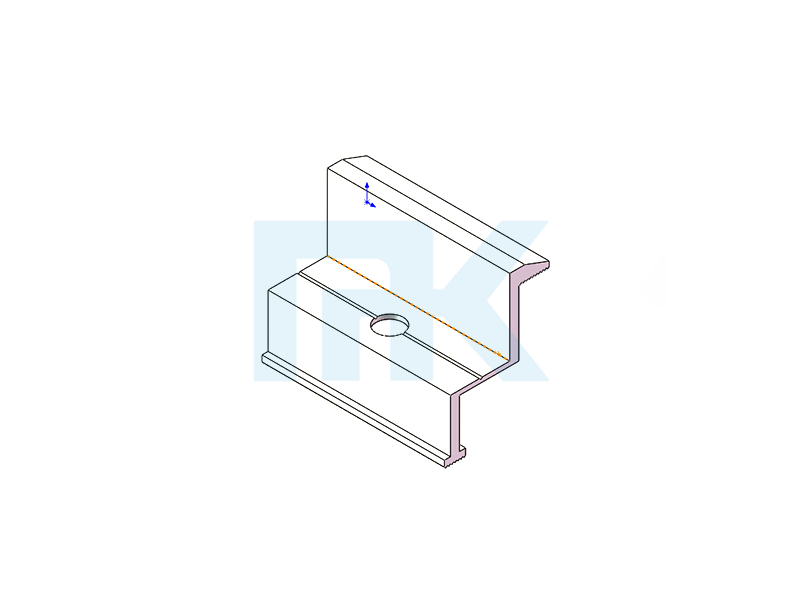
A mid clamp sits in the gap between two adjacent solar panels in the same row. Its profile is symmetrical — it has two clamping flanges that each grip the frame of one panel on either side — so a single mid clamp secures two panels simultaneously. The bolt passes through the centre of the clamp body and threads into a T-bolt or hammer head nut that slides along the mounting rail channel below. When the bolt is tightened to the specified torque, the clamp flanges press down on both panel frames with equal force, preventing the panels from lifting or shifting laterally. Because each mid clamp serves two panels, the number of mid clamps required in any row is equal to the number of panel-to-panel joints — one panel fewer than the total count in the row.
End Clamps: At the Outside Edges of Each Row
An end clamp secures the outermost panel in each row — the panels at the left and right ends that have no adjacent neighbour to be held by a mid clamp. An end clamp has a single clamping flange on one side only, with a lip or hook profile that wraps around the outside edge of the panel frame. This prevents the panel from moving outward off the rail. Two end clamps are needed per row — one at each end — regardless of how many panels are in the row. End clamps are often slightly more robust in cross-section than mid clamps because they must resist lateral loads applied to the panel at the array perimeter, where wind-induced forces are typically highest.
| Feature | Mid Clamp | End Clamp |
|---|---|---|
| Position in Row | Between adjacent panels | At the outermost panel on each end |
| Clamping Flanges | Two (grips one panel on each side) | One (grips outside edge of one panel) |
| Panels Secured per Clamp | Two | One |
| Quantity per Row | (Number of panels) – 1 | Always 2 per row |
| Primary Load Resisted | Vertical uplift, in-row lateral shift | Lateral outward movement, uplift at array edge |
Aluminium Alloy Grades: Why 6005-T5 Is the Industry Standard
Not all aluminium is equal. The specific alloy and temper used in solar clamp manufacturing determine the component's structural strength, corrosion resistance, and long-term durability. Understanding why certain grades are specified — and what the designation means — helps buyers distinguish quality components from cheap alternatives that may underperform in the field.
The dominant specification for aluminium solar clamps is 6005-T5, with 6061-T6 also used by some manufacturers. The first number (6xxx series) indicates that the alloy is silicon-magnesium based — a family known for its balance of strength, corrosion resistance, and extrudability. The T designation indicates the temper (heat treatment state): T5 means the component was cooled from an elevated-temperature shaping process and then artificially aged to achieve strength; T6 means it was solution heat-treated and then artificially aged. Both produce components with high tensile strength appropriate for structural fastening applications.
What matters practically: 6005-T5 aluminium offers tensile strength of around 260 MPa and excellent resistance to outdoor corrosion, particularly when anodized. The anodizing process — electrochemically growing a thicker aluminium oxide layer on the component surface — significantly enhances corrosion resistance and abrasion resistance. Most reputable solar clamp manufacturers specify an anodizing thickness of 10–15 microns. Components with no anodizing or a very thin anodic layer will oxidize more rapidly in coastal, industrial, or high-humidity environments, potentially causing the clamp to seize on the bolt threads or lose dimensional integrity over a 25-year service life.
The Grounding and Bonding Function of Solar Clamps
In most solar installations, aluminium mounting clamps do more than hold panels mechanically — they also serve a critical electrical function. PV systems must be grounded and bonded to protect people and equipment from fault currents and lightning. The clamps, when they make reliable metal-to-metal contact with the panel frame and the mounting rail, can form part of the bonding path that provides this protection. This dual function is one reason why the material quality and surface condition of solar clamps are taken seriously in professional installations.
How Clamp-Based Grounding Works
A grounded PV system connects all exposed metal components — panel frames, rails, racking structure — into a continuous electrical pathway that is then connected to earth ground. When a clamp is installed, it contacts both the panel frame above and the mounting rail below. If both the clamp and the rail are made from conductive aluminium and the contact surfaces are clean and tight, the clamp creates a bonding connection between those two metal surfaces. Many modern aluminium solar clamps incorporate integrated grounding teeth, serrations, or bonding pins that pierce the anodic oxide layer on the panel frame and rail surface to ensure a reliable low-resistance electrical connection — the anodic layer is an insulator, and without penetration features, the bond may be unreliable.
UL 2703 Certification and Grounding Compliance
In the United States, the standard that governs solar mounting clamps and their grounding function is UL 2703 — the Standard for Mounting Systems, Mounting Devices, Clamping/Retention Devices, and Ground Lugs for Use with Flat-Plate Photovoltaic Modules and Panels. UL 2703 covers rack mounting systems and clamping devices with respect to grounding and bonding paths, mechanical strength, fire classification, and material suitability for systems up to 1,000 V maximum system voltage. A clamp that carries UL 2703 listing has been independently tested and verified to meet these requirements. For commercial and utility installations in the US, specifying UL 2703-listed clamps is typically a permit and inspection requirement, not merely a recommendation. In European markets, the equivalent framework is the CE marking combined with IEC 61215 and EN 1090 structural compliance for mounting systems.
When Separate Grounding Lugs Are Still Needed
Not all clamp designs provide code-compliant grounding by themselves. Clamps without integrated bonding teeth or bonding pins may require separate grounding lugs attached to the panel frames and rails to complete the bonding path. The installation documentation for UL 2703-listed clamps specifies whether the clamp alone establishes the bonding path or whether additional grounding hardware is required. Installers who substitute non-listed clamps or skip the grounding documentation review create liability for code violations that may not be discovered until final inspection — or worse, after a fault event.
Frame Height and Size Compatibility: Getting the Dimensions Right
Aluminium solar clamps are manufactured in specific sizes to match the frame height of the panels being installed. Using a clamp that is too small will not grip the frame adequately; using one that is too large leaves the clamping flange floating above the frame surface, applying no useful force. Frame height is measured as the depth of the aluminium extrusion that forms the panel's perimeter frame — typically between 30 mm and 50 mm for current commercial and residential solar panels, with 35 mm and 40 mm being the most common dimensions in the market.
Standard size offerings from reputable manufacturers cover 30 mm, 32 mm, 33 mm, 35 mm, 37 mm, 40 mm, 45 mm, and 50 mm frame heights. Some adjustable clamp designs accommodate a range of frame heights within a single component — for example, an adjustable end clamp rated for 30–50 mm — which is useful for installers working with mixed panel types or stocking a single clamp SKU for multiple projects. Always confirm the exact frame height of the specific panel model being installed from the panel manufacturer's datasheet before ordering clamps. Panel frame height varies not only between manufacturers but sometimes between product families from the same manufacturer.
Fastener Hardware: Stainless Steel Bolts, T-Bolts, and Washers
The aluminium clamp body is only one part of the fastener assembly. The hardware that transfers the clamping force — the bolt, the rail nut, and any washers — is equally critical to the long-term integrity of the connection. Galvanic corrosion is the primary risk: when dissimilar metals are in contact in the presence of an electrolyte (rainwater, humidity), the less noble metal corrodes preferentially. Aluminium clamps in contact with standard carbon steel bolts will accelerate corrosion of the steel, leading to bolt failure over years of outdoor exposure.
The industry standard for solar clamp hardware is stainless steel 304 (SUS304) or 316 (SUS316) for all bolts, washers, and nuts. SUS304 is appropriate for most inland installations; SUS316 — with its higher molybdenum content for superior chloride resistance — is the correct specification for coastal, marine, and industrial environments where salt or chemical exposure is expected. The complete hardware kit for each clamp typically includes the aluminium clamp body, one stainless steel bolt (M6 or M8 depending on design), one T-bolt or hammer head nut sized for the rail channel, and a flat washer. Pre-assembled clamp kits, packaged in sets of 100 for jobsite efficiency, are the standard format from major suppliers.
Installation: Torque, Position, and Common Errors
Correct installation of aluminium solar clamps is straightforward, but several consistent errors in the field lead to panel damage, loose arrays, or failed inspections. Following the manufacturer's installation instructions and the panel manufacturer's clamping zone requirements is essential — it is also a condition of maintaining the panel warranty and any structural compliance certification.
Clamping Zone Requirements
Solar panel manufacturers specify where along the panel frame clamps may be placed — these are called clamping zones. Placing a clamp outside the permitted zone (too close to the corner of the panel, for example) concentrates mechanical stress on the panel glass and frame in ways the module was not designed to handle, which can cause micro-cracks in cells or frame deformation. REC and most major panel manufacturers require that each panel is secured at least once in each of four defined zones. The exact clamping zone boundaries are shown in the panel's installation manual and vary by panel model — this means the rail spacing and clamp positions must be designed to the specific panel being installed, not assumed from a previous project using different panels.
Torque Specifications
Every aluminium solar clamp has a specified installation torque for its fastener bolt. The torque must be sufficient to generate the clamping load required by UL 2703 or the applicable standard — typically in the range of 7 ft-lbs to 10 ft-lbs (approximately 9.5 to 13.5 N·m) depending on the clamp design and bolt size. Under-torquing leaves inadequate clamping force and allows the panel to move under wind or thermal cycling. Over-torquing can crack the aluminium clamp body, strip the bolt threads, or damage the panel frame. A calibrated torque wrench is not optional on professional installations — it is the only reliable way to confirm that the correct torque has been applied. Anti-seize compound should be applied to the bolt threads of aluminium-on-stainless assemblies to prevent galling and to ensure the torque reading accurately reflects the clamping load rather than friction losses on the thread.
Gap Between Panels at Mid Clamps
Mid clamps establish the spacing between adjacent panels. Most racking system guidelines require a minimum gap of 6 mm (approximately 1/4 inch) and a maximum of 25 mm (approximately 1 inch) between panel frames at each mid clamp position. The minimum gap allows for thermal expansion and panel installation tolerances without panels pressing against each other; the maximum gap ensures that the clamp flanges adequately engage both frames. Consistent panel spacing also affects array aesthetics — uneven gaps are visible from the ground on residential installations and are often flagged during homeowner final walkthroughs.
Anti-Seize and Thread Lock
Aluminium-to-stainless steel contact can gall (cold-weld at the thread interface) under torque if no thread lubricant is used, making the bolt impossible to remove later without damage. Applying a thin coat of silver-grade anti-seize to the bolt shank before installation prevents galling, ensures accurate torque application, and allows the bolt to be removed for maintenance or replacement without destroying the clamp or rail nut. After torquing, thread lock adhesive applied to the exposed threads provides secondary retention against vibration-induced loosening over the service life of the array.
Frameless and Thin-Film Panel Clamps: A Different Problem
Standard mid and end clamps are designed for framed solar panels — modules with an extruded aluminium border that provides the surface the clamp grips. An increasing proportion of solar installations now use frameless bifacial glass-glass panels or thin-film panels, which require entirely different mounting hardware.
Frameless panel clamps use rubber-cushioned or polymer-lined clamping surfaces that grip the glass edges directly without the benefit of a rigid frame to transfer load. The clamping force must be distributed evenly to avoid concentrating stress on the glass edge, which can cause edge chips and cracks that propagate under thermal and mechanical cycling. Thin-film mid clamps for flexible or laminate panels — used in building-integrated PV (BIPV) and specialty applications — are longer (80 mm to 200 mm is common) to spread load across a larger contact area and accommodate the different panel profile. These are specialty products manufactured to specific project requirements and are not interchangeable with standard framed-panel hardware.
What to Check Before Buying Aluminium Solar Clamps
The market for aluminium solar clamps spans from high-quality certified components to cheap, uncertified alternatives that may look identical but underperform in service. Working through the following checklist before purchasing protects both the installation and the long-term performance of the system.
- Confirm the panel frame height: Check the exact frame height in millimetres from the panel manufacturer's datasheet — not from a product photo or a rule of thumb. Order clamps specified for that exact dimension, or confirm the adjustable range of any variable-size clamp covers your panel's frame height with meaningful engagement, not just at the extreme end of the adjustment range.
- Verify alloy grade and anodizing specification: The clamp should be manufactured from 6005-T5 or 6061-T6 aluminium alloy with anodizing to a minimum of 10 microns. Confirm this in writing from the supplier — do not accept "aluminium alloy" as a sufficient material specification for components intended for 25-year outdoor service.
- Check for UL 2703 listing or equivalent certification: For US installations, confirm UL 2703 listing. For European markets, confirm CE marking and any relevant IEC compliance. Request the listing documentation and confirm that the specific clamp model — not just the supplier's broader product range — carries the certification. UL 2703 listing is specific to individual component designs, not company-wide approvals.
- Confirm integrated grounding capability: Determine whether the clamp provides a code-compliant bonding path on its own — through integrated grounding teeth or bonding pins — or whether additional grounding hardware will be required. This affects both cost and installation time. Confirm compatibility with the specific panel model's frame anodizing, as some panel frames require specific bonding pin geometry to achieve the required low-resistance connection.
- Confirm stainless steel hardware grade: All bolts, nuts, and washers in the kit should be SUS304 as a minimum. For coastal or marine installations, specify SUS316. Confirm the hardware grade from the supplier — fasteners sold as "stainless steel" vary widely in actual alloy content, and low-grade stainless corrodes far faster than SUS304 in outdoor exposure.
- Check rail compatibility: The T-bolt or hammer head nut must match the channel profile of the mounting rail being used. Rail channel dimensions vary between racking system brands. Most clamp suppliers list compatible rail profiles or offer T-bolts in multiple widths — confirm compatibility with your specific rail before ordering, particularly if mixing components from different manufacturers.
- Evaluate warranty and documentation: Reputable suppliers offer a 10-year component warranty and 25-year expected service life. Request load testing data — the clamp's rated pull-out and slide-out resistance under static load — particularly for commercial or utility projects where structural engineering review requires verified component performance data.