English
 عربى
عربى BLDC
BLDC

Content
- 1 What Are Aluminium Solar Rails and Why Are They the Industry Standard?
- 2 Aluminium Alloy Grades Used in Solar Rail Manufacturing
- 3 Solar Rail Profile Types and Cross-Sectional Designs
- 4 Structural Performance: Span Tables and Load Ratings for Aluminium Solar Rails
- 5 Key Components That Work with Aluminium Solar Rails
- 6 Orientation Options: Portrait vs. Landscape Rail Layout
- 7 Installation Best Practices for Aluminium Solar Mounting Rails
- 8 Comparing Aluminium Solar Rails: Key Specifications to Evaluate
What Are Aluminium Solar Rails and Why Are They the Industry Standard?
Aluminium solar rails are the extruded aluminum structural members that form the primary mounting framework of rooftop and ground-mounted photovoltaic (PV) systems. They run horizontally or vertically across roof attachment points or racking posts, providing the continuous bearing surface onto which solar panel mid-clamps and end-clamps are bolted to secure each module in position. The rail transfers all mechanical loads — panel weight, wind uplift, wind pressure, and snow accumulation — from the solar array back to the building structure or ground foundation through the mounting hardware, making the structural integrity of the aluminum solar mounting rail the foundational element of a safe and code-compliant PV installation.
Aluminium has become the universal material choice for solar panel rails for a combination of reasons that no competing material can fully replicate. Its density of approximately 2.7 g/cm³ is roughly one-third that of steel, making aluminum solar racking rails light enough for a single installer to handle on a rooftop without mechanical assistance, while the material's excellent corrosion resistance — provided by a naturally forming aluminum oxide passivation layer further enhanced by anodizing or powder coating — ensures a service life that matches or exceeds the 25 to 30-year performance warranty period of the solar modules themselves. The material's high electrical conductivity also simplifies grounding and bonding requirements, and its compatibility with standard aluminum extrusion manufacturing allows complex cross-sectional profiles to be produced at high volume with the dimensional consistency that modern solar mounting clamp systems require.
Aluminium Alloy Grades Used in Solar Rail Manufacturing
The structural performance, corrosion resistance, and long-term durability of an aluminum solar rail are directly determined by the alloy and temper specification of the material from which it is extruded. Not all aluminum alloys are equally suited to the outdoor structural demands of solar racking, and understanding the relevant alloy designations helps specifiers and buyers evaluate the quality claims of solar rail manufacturers.
6005A-T5 and 6005A-T6 Alloy
6005A aluminum alloy in T5 or T6 temper is the most widely used specification for structural solar mounting rails globally. This alloy belongs to the 6xxx series (aluminum-magnesium-silicon), which offers the optimal balance of extrudability, mechanical strength, and corrosion resistance for complex profile solar rail cross-sections. The T5 temper — artificially aged after extrusion cooling — provides a minimum tensile strength of approximately 260 MPa and a yield strength of 240 MPa, while the T6 temper — solution heat-treated and artificially aged — further elevates these values to approximately 270 MPa tensile and 255 MPa yield. These strength levels are more than adequate for residential and commercial solar rail applications, and the alloy's resistance to intergranular corrosion in marine and industrial atmospheric environments makes it reliable across a wide range of installation climates without additional protective treatment beyond standard anodizing.
6061-T6 Alloy
6061-T6 aluminum is the most broadly recognized structural aluminum alloy in North American and global markets, and many solar rail manufacturers specify it for its well-documented mechanical properties and widespread acceptance by structural engineers and building officials during permit review. With a minimum tensile strength of 310 MPa and yield strength of 276 MPa, 6061-T6 solar rails offer higher structural capacity than 6005A-T5 equivalents at the same cross-sectional dimensions, enabling longer unsupported spans between attachment points — a meaningful advantage in roof layouts where attachment spacing is constrained by rafter positions or structural limitations. The alloy's weldability and machinability also facilitate custom fabrication of splice connections and end caps at the installation site.
Surface Treatment: Anodizing vs. Powder Coating
Aluminum solar rails are surface-treated after extrusion to provide enhanced corrosion protection and, in many cases, an aesthetic finish that complements roof color. Anodizing — an electrochemical process that thickens the natural aluminum oxide layer to 10–25 microns — is the standard treatment for structural solar rails, providing excellent corrosion resistance, UV stability, and abrasion resistance without adding significant thickness or weight. Clear anodized rails have a natural silver-aluminum appearance, while black anodized aluminum solar rails are increasingly specified for residential installations where visual integration with dark roof surfaces or all-black solar panel aesthetics is a priority. Powder coating provides a broader color range and a uniform matte or gloss finish, but adds 60–80 microns of coating thickness and requires careful specification to ensure the powder coat formulation is rated for the full outdoor UV and temperature cycling exposure of a solar installation environment.
Solar Rail Profile Types and Cross-Sectional Designs
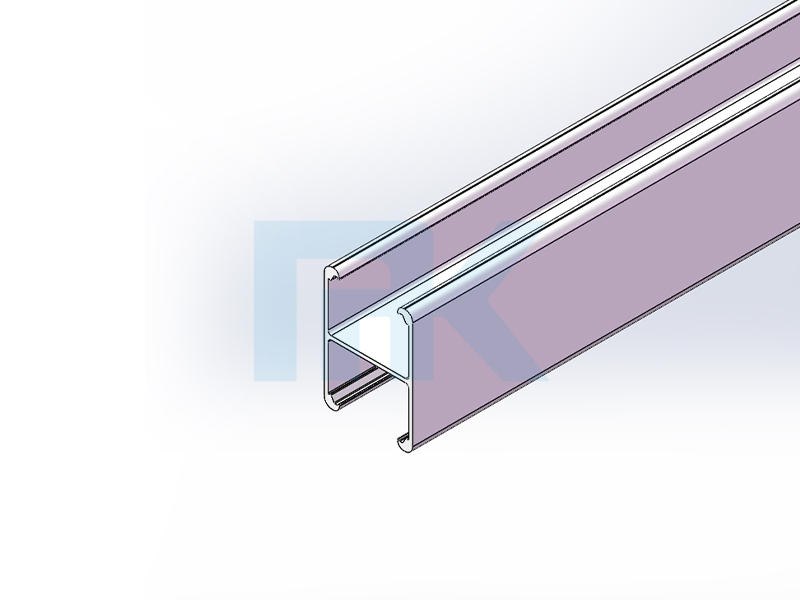
The cross-sectional profile of an aluminum solar panel rail determines its structural efficiency, the types of mounting hardware compatible with it, its weight per meter, and the installation method required. Solar rail profiles have evolved significantly from simple rectangular tubes toward highly engineered geometries that optimize structural performance while minimizing material usage and installation complexity.
Top-Hat (Hat Channel) Profile Rails
The top-hat or hat-channel profile is among the most widely used solar mounting rail cross-sections globally, characterized by a rectangular or trapezoidal upper channel flanked by two outward-facing flanges at the base. The top channel accepts T-bolts or sliding nuts that can be positioned anywhere along the rail's length to accommodate varying panel sizes and irregular attachment spacing without pre-drilling. This T-slot mounting system is the foundation of most major solar racking brands including Unirac, IronRidge, and Renusol, and the standardization of T-slot dimensions across the industry has created a largely interchangeable ecosystem of compatible clamps, splice connectors, and mounting accessories. The hat channel profile's open base section allows electrical wiring and conduit to be routed beneath the rail, providing a clean installation with concealed cable management.
C-Channel and Z-Rail Profiles
C-channel aluminum solar rails feature a simple C-shaped cross-section that provides high moment of inertia relative to material weight, making them structurally efficient for longer-span applications such as carport solar structures, ground-mount systems, and flat roof ballasted racking where maximizing span between support posts reduces overall foundation cost. Z-rail profiles — asymmetric cross-sections with opposing flanges at different heights — are used in specific flush-mount roof systems where the rail must bridge between attachment points at different elevations to maintain a consistent panel plane across an irregular roof surface. Both profile types typically incorporate T-slot grooves or pre-punched mounting holes for panel clamp attachment.
Mini-Rail and Low-Profile Rail Systems
Mini-rail aluminum solar mounting systems use significantly smaller cross-sectional profiles — typically 30–40 mm height versus 40–60 mm for standard rails — to reduce the visual profile of the mounting system on residential rooftops. These low-profile aluminum solar rails are engineered for shorter panel spans and higher attachment frequency, requiring more roof penetrations per array than standard rail systems but resulting in a sleeker, lower-silhouette installation that many residential customers prefer aesthetically. Mini-rail systems are most appropriate for lightweight residential modules on well-structured roofs with accessible rafters at regular spacing.
Structural Performance: Span Tables and Load Ratings for Aluminium Solar Rails
The allowable span between support attachments — the maximum unsupported length of aluminum solar rail between two mounting feet or standoffs — is the critical structural specification that determines how many roof penetrations are required per rail and whether a proposed installation layout is structurally sound for the site's wind and snow load conditions. Span capability is a function of rail cross-sectional geometry, alloy strength, and the applied loads calculated from site-specific wind speed, snow ground load, and panel weight data.
| Rail Profile Type | Alloy / Temper | Typical Height (mm) | Max Span (Low Load Zone) | Max Span (High Load Zone) |
| Standard Hat Channel | 6005A-T5 | 40–46 | Up to 2,200 mm | Up to 1,400 mm |
| Heavy-Duty Hat Channel | 6061-T6 | 50–60 | Up to 3,000 mm | Up to 1,800 mm |
| Mini Rail | 6005A-T5 | 30–38 | Up to 1,600 mm | Up to 1,000 mm |
| C-Channel Ground Mount | 6061-T6 | 60–80 | Up to 4,000 mm | Up to 2,400 mm |
These span values are indicative ranges based on typical residential loading conditions. Actual allowable spans must always be determined from the rail manufacturer's certified span tables using the specific wind and snow loads calculated for the installation site per the applicable structural design standard — ASCE 7 in the United States, AS/NZS 1170 in Australia and New Zealand, or EN 1991 Eurocode in European jurisdictions. Installing aluminum solar rails at spans exceeding the manufacturer's certified limit for site conditions is a code violation that voids the product warranty and creates installer liability for structural failures.
Key Components That Work with Aluminium Solar Rails
Aluminum solar rails function as part of an integrated mounting system, and their performance and ease of installation depend on the quality and compatibility of the associated hardware components. Understanding the full component ecosystem helps installers select compatible parts and avoid the mix-and-match compatibility problems that slow installation and compromise structural integrity.
- Mid-Clamps and End-Clamps: Panel clamps grip the frame of each solar module to the aluminum mounting rail. Mid-clamps secure two adjacent panels simultaneously at their shared frame edges, while end-clamps secure the outer edge of the first and last panel in each row. Clamp height must match the panel frame thickness — typically 30–46 mm for residential modules — and clamps are available in fixed and adjustable-height versions to accommodate mixed-thickness panels or specific aesthetic requirements.
- T-Bolts and Sliding Nuts: T-bolts and hammer-head nuts slide into the T-slot channel of the aluminum solar rail and can be positioned anywhere along the rail's length before tightening, enabling clamp placement to be adjusted to exact panel frame locations without pre-drilling or measuring hole positions. The dimensional accuracy of the T-slot profile is critical — oversized slots allow bolt head rotation during tightening while undersized slots prevent smooth sliding and position adjustment.
- Rail Splice Connectors: Aluminum solar rail sections are joined end-to-end using internal or external splice connectors — short aluminum extrusions or cast aluminum blocks that insert into or over the rail ends and are secured with fasteners. A properly designed splice connector transfers bending moment across the joint, maintaining structural continuity of the rail over its full length. The splice location must comply with the manufacturer's maximum splice offset specification from the nearest support point — typically no more than 20% of the span length from the attachment point — to ensure the splice junction is not located at the point of maximum bending stress.
- Flashing Mounts and L-Foot Attachments: The interface between the aluminum solar rail and the roof structure is made through flashing mounts — waterproof roof penetration assemblies that bolt through the roof deck into a rafter — topped with an L-foot bracket that provides the vertical standoff height to bring the rail to the correct elevation above the roof surface. The flashing assembly is the most critical waterproofing point in a rooftop solar installation, and using roof-specific flashing designed for the roofing material type — composition shingle, tile, metal standing seam — is mandatory for maintaining roof warranty and preventing water infiltration.
- Grounding Lugs and Bonding Hardware: Electrical grounding of the aluminum solar rail system is required by NEC Article 690 in the United States and equivalent standards internationally. Grounding lugs that pierce the anodized or powder-coated rail surface to make direct metal-to-metal contact, or grounding clips that bond rail sections together, are incorporated at specified intervals along the rail to ensure the entire metallic racking structure is at equipotential — a critical safety requirement that prevents dangerous voltage differentials on the array structure in the event of a ground fault.
Orientation Options: Portrait vs. Landscape Rail Layout
The orientation of solar panels relative to the aluminum rail direction — whether panels are mounted in portrait (tall) or landscape (wide) orientation — has significant implications for the number of rails required, the attachment spacing needed, and the structural loads each rail must carry. Both orientations are structurally valid, and the choice is typically driven by roof geometry, rafter layout, and system design software optimization.
Portrait Orientation with Two Rails
Portrait-oriented panels mounted on two horizontal aluminum solar rails — one crossing near the top of the panel frame and one near the bottom — is the most common residential installation configuration in markets using 60-cell and 72-cell modules. This two-rail portrait layout places the rails across the panel's short dimension, typically spanning 1,000 to 1,100 mm between rail lines, and allows the rails to run continuously across the full width of the array with mid-clamps positioned at each panel long-edge. The two-rail portrait configuration requires more total rail length than landscape layouts but provides straightforward clamp alignment and is compatible with the widest range of standard mounting hardware.
Landscape Orientation with Two or Three Rails
Landscape-oriented panels on two rails place the module's long dimension parallel to the aluminum mounting rails, with the rails crossing near the two short edges of the panel. This orientation is common in commercial rooftop installations using large-format 72-cell or 120-half-cell modules where the extended panel height in portrait orientation would require the rails to be spaced beyond the allowable span for the site's load conditions. Three-rail landscape systems — with a central support rail in addition to the two edge rails — are specified for large-format modules exceeding approximately 2,100 mm in height, or in high wind and snow load regions where the panel center-span deflection under load would exceed allowable limits without mid-support.
Installation Best Practices for Aluminium Solar Mounting Rails
Correct installation of aluminum solar rails requires attention to layout precision, fastener torque, thermal expansion accommodation, and grounding continuity — all of which directly affect the structural safety, weathertightness, and long-term performance of the completed PV system. The following best practices reflect requirements from leading rail manufacturers and NEC/IEC installation standards.
Laying Out Rail Lines and Attachment Positions
Rail layout begins with locating rafter positions beneath the roof cladding using a stud finder or by measuring from known rafter reference points at the roof eave. All flashing mount attachments must engage a rafter with a minimum of 38 mm (1.5 inches) of fastener embedment into solid framing lumber — attachment into roof sheathing alone is not structurally acceptable and will not pass inspection. Chalk lines snapped across the roof surface establish the rail line positions, and flashing mount positions along each rail line are set at the attachment spacing determined from the manufacturer's span table for site conditions. Rail lines must be parallel to each other within ±3 mm over the full array length to ensure panel frames sit flat on both rails simultaneously without rocking or twisting stresses at the clamp points.
Thermal Expansion Gaps at Rail Splices
Aluminum expands and contracts with temperature at a coefficient of approximately 23 × 10⁻⁶/°C — significantly more than steel. A 6-meter aluminum solar rail will expand and contract by approximately 14 mm between a cold winter night at -10°C and a hot summer roof surface at 70°C. Failing to accommodate this thermal movement at splice connections causes the rail to buckle, bow, or apply damaging forces to the flashing mount attachments. Most rail manufacturer installation manuals specify a thermal expansion gap of 6–10 mm between rail section ends at each splice connector, and some systems use floating splice connectors that allow the rail ends to slide independently within the splice sleeve rather than being rigidly bolted. Always confirm and maintain the specified expansion gap during installation — do not close the gap by pushing rail sections together before fastening the splice hardware.
Fastener Torque Specifications
All fasteners in an aluminum solar rail system — flashing mount lag screws, L-foot bolts, T-bolt and clamp assemblies, and splice connector fasteners — must be torqued to the manufacturer's specified values using a calibrated torque wrench. Over-torquing T-bolt clamp assemblies is one of the most common installation errors, crushing the panel frame corner where the clamp makes contact and potentially cracking the module frame or glass. Under-torquing allows clamps to loosen over time under cyclic wind loading, eventually allowing panel movement that fatigues the frame and damages the module. Standard mid-clamp and end-clamp torque values for aluminum-framed modules typically fall in the range of 8–16 N·m depending on clamp size and module manufacturer specification — always verify the module manufacturer's clamping requirements as these supersede generic racking hardware torque guidelines.
Dissimilar Metal Corrosion Prevention
Where aluminum solar rails contact steel hardware — particularly galvanized steel flashing mounts, steel lag screws, or stainless steel fasteners — galvanic corrosion can occur in the presence of moisture, particularly in coastal and high-humidity environments. Stainless steel fasteners (Grade 316 in marine environments, Grade 304 elsewhere) are strongly preferred over galvanized steel for all contacts with aluminum rail components, as the galvanic potential difference between stainless steel and aluminum is significantly lower than between carbon steel and aluminum. Where dissimilar metals cannot be avoided, applying a thin layer of anti-seize compound or installing isolating washers at the contact interface provides a moisture barrier that prevents galvanic cell formation and preserves the corrosion protection of both materials over the system's service life.
Comparing Aluminium Solar Rails: Key Specifications to Evaluate
With dozens of aluminum solar rail products available from manufacturers ranging from established brands with certified engineering documentation to commodity importers offering minimal technical support, knowing which specifications to evaluate helps buyers make informed purchasing decisions that protect both installation quality and long-term liability exposure.
- Alloy and Temper Certification: Request material test certificates (MTC) confirming the alloy designation and temper of the aluminum used. Reject any supplier unable to provide third-party certified material documentation, as substandard alloy substitution is a known quality issue in commodity solar rail supply chains.
- Published Span Tables with Load Inputs: Quality solar rail manufacturers publish certified span tables generated from structural analysis compliant with relevant design standards. Tables should specify the wind pressure and snow load inputs used, the panel tributary width assumed, and whether the values represent allowable stress design (ASD) or load and resistance factor design (LRFD) methodology.
- Section Modulus and Moment of Inertia: These cross-sectional properties, typically published in the rail datasheet, allow structural engineers to independently verify span capacity and adapt published span tables to non-standard loading conditions or international design standards.
- Anodize Thickness and Class: Anodizing should meet a minimum of Class I (18 micron) coating thickness for exterior architectural applications per AAMA 611 or equivalent standard. Thinner Class II (10 micron) anodizing is acceptable for inland low-corrosion environments but is insufficient for coastal or industrial atmospheric exposure categories.
- UL 2703 or Equivalent Listing: In North American markets, UL 2703 listing of the complete racking system — including rails, clamps, and grounding hardware — confirms that the system has been independently tested for structural performance, bonding and grounding continuity, and fire classification. UL 2703 listed systems are required or strongly preferred by many AHJs (Authorities Having Jurisdiction) for permit approval and are increasingly required by commercial project specifications.
- Weight per Meter and Standard Lengths: Rail weight per linear meter determines shipping cost and on-roof handling requirements. Standard rail lengths of 3.3 m, 4.0 m, or 6.0 m affect the number of splices required for a given array dimension and the amount of cut-off waste generated during installation — factors that influence both material cost and labor productivity.