English
 عربى
عربى BLDC
BLDC

One of our customers had a machine frame that started to sag after six months. The 40-series aluminum profiles were fine, but three of the aluminum corner brackets had begun to loosen under continuous vibration. The bolts were still at torque, but the bracket material had deformed over time, which slackened the joint. We replaced those brackets with zinc-plated carbon steel gussets, and the frame has been rigid since. That is the simplest way to describe why carbon steel T-slot connectors matter: for heavy frames under real vibration, they hold longer and usually cost less. The rest of this article explains what the differences are, how to read load ratings, and where the common procurement mistakes happen.
Content
Why Carbon Steel Connectors Earn Their Place in T-Slot Frames
Conclusion first: carbon steel T-slot connectors beat aluminum alloy connectors on tensile strength, stiffness, and cost per unit of load capacity in most indoor industrial frames. Their weakness is corrosion resistance, which is why plating and sealing are part of the specification.
Carbon steel has a Young's modulus of about 210 GPa, roughly three times that of aluminum at 70 GPa. That means a steel connector deforms much less under the same load. For T-slot frames, the practical result is fewer alignment issues over time. A steel anchor fastener in an M8 slot can take pull-out loads in the range of 3500-4500 N in a clean 40-series profile, while a comparable aluminum fastener typically reaches a lower ceiling before yielding.
Vibration is not the only load case. Frames supporting rotating equipment, conveyor drives, or press operations see repeated cyclical stress. Carbon steel's fatigue strength at 10 million cycles is substantially higher than aluminum's, which means connectors are less likely to develop micro-cracks at the thread root or bracket base. This is why machine builders specify carbon steel for joints that carry dynamic loads.
Cost is another argument. A zinc-plated carbon steel bolt or anchor fastener is usually 20-40% cheaper than the same size in aluminum alloy or stainless steel. When you build a conveyor frame with forty joints, the savings add up.
The trade-off appears when moisture, chemicals, or outdoor exposure are present. Carbon steel without plating will rust. For indoor workshop use, machine frames, safety fences, and workbenches, carbon steel is the practical choice. For outdoor solar structures or food-contact equipment, stainless steel may be worth the higher price.
Common Types of Carbon Steel T-Slot Connectors
The connector family is wider than most buyers expect. Each type distributes load differently, and selecting the wrong one is the fastest way to end up with a frame that twists. The full T-slot connectors range on this site covers anchor fasteners, spring fasteners, corner brackets, and die-cast gusset brackets.
Anchor Fasteners
Anchor fasteners are inserted from the profile end and pull from inside the slot. The hidden design keeps the frame clean, which is why workstations and display frames use them. The load goes through a steel nut and bolt, so material grade matters more than appearance. Choose grade 8.8 bolts for frames that need disassembly and re-tightening. With anchor fasteners, the slot wall carries the reaction force, so the profile series must match the fastener size exactly.
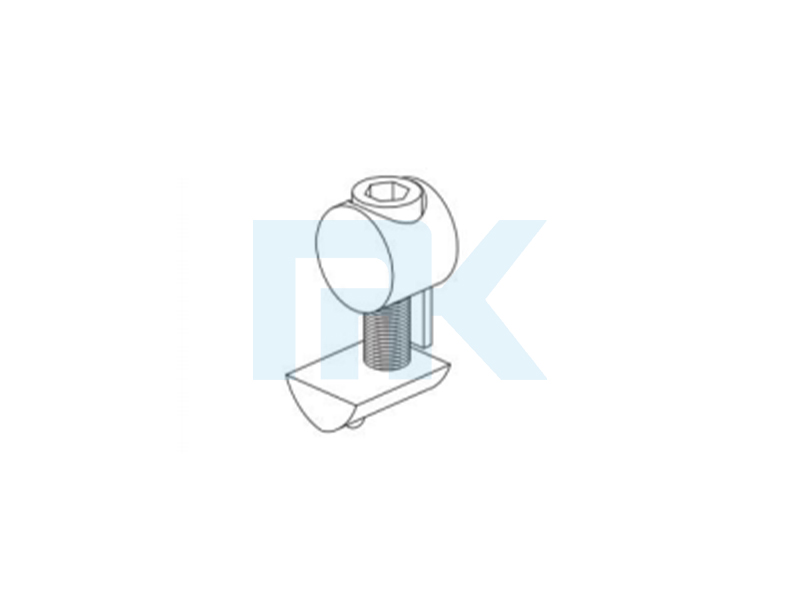 Anchor Fastener for T-Slot Aluminum ProfilesAnchor fasteners insert from the profile end and pull from inside the slot, offering a clean hidden joint ideal for workstations and display frames. They carry load through a steel nut and bolt, so match the profile series exactly for reliable assembly.View Product →
Spring Fasteners
Spring fasteners use a spring steel ball or leaf to hold the connector in place before the bolt is tightened. They speed up assembly because nothing falls out while you reposition the profile. The spring itself is normally carbon spring steel. Avoid them in heavy vibration environments; the spring can fatigue over time. For quick-setup workstations and prototype frames, though, the assembly time savings are real.
Corner Brackets
Corner brackets sit on the outside of the profile and bolt through the slot. They are visible, but they make the joint easy to adjust and reinforce. The 90-degree version is the most common; the 45-degree version is useful for angled frames. The bracket body may be die-cast aluminum, while the bolts and inserts are carbon steel. Check the components as a set, not just the bracket housing. If the bracket is aluminum, pair it with steel bolts and steel sliding nuts to get the best balance of stiffness and price.
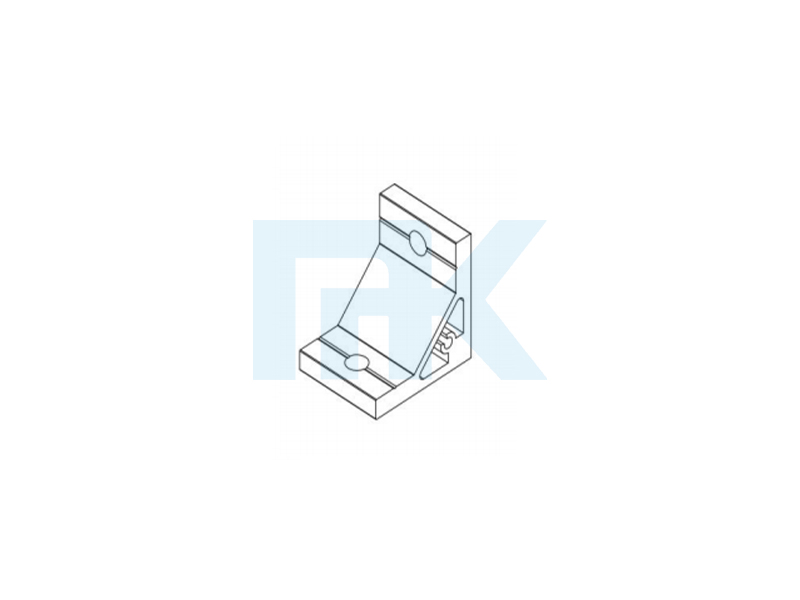 90-Degree Aluminum Extrusion Corner BracketThis external corner bracket bolts through the slot for easy adjustment and reinforcement. It is the most common 90-degree connector for modular frames, providing a visible but accessible joint that can be combined with steel bolts and sliding nuts for balanced stiffness and cost.View Product →
Die-Cast Gusset Brackets
Die-cast gusset brackets add a triangular brace to a corner joint. They are the go-to parts when a frame has a long cantilever or when the frame supports a heavy door or shelf. The gusset distributes bending stress away from the slot edge, reducing the risk of the profile wall tearing. For frames that must hold calibration devices or measurement tools, the extra rigidity is often the deciding factor.
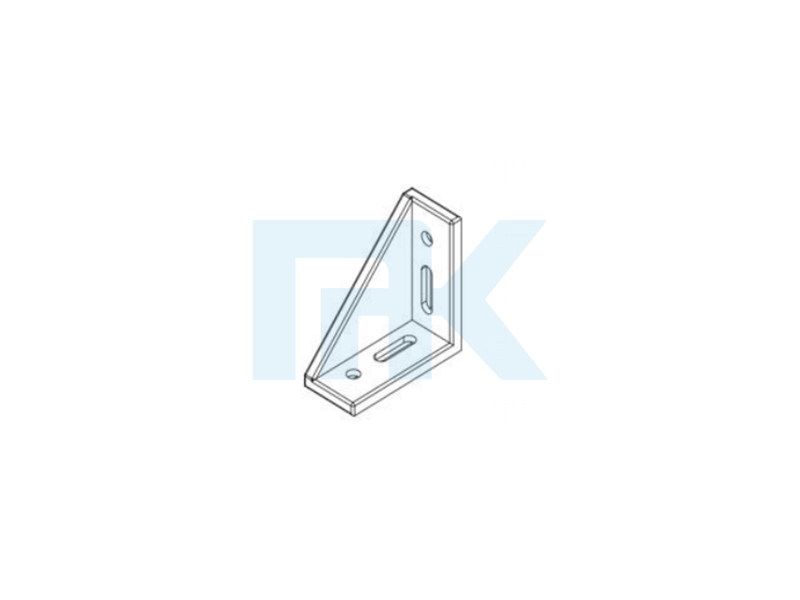 Die-Cast Gusset Bracket for Corner ReinforcementA triangular die-cast gusset brace adds rigidity to corner joints, distributing bending stress away from the slot edge. It is essential for frames with cantilevers or heavy loads, preventing profile wall tearing and ensuring stability for precision equipment.View Product →
Load Capacity and Technical Specifications
Load ratings are highly dependent on the profile series, bolt size, and whether the connector is a bolt-through or edge-grab design. The table below shows typical working values.
| Connector Type | Typical Material | Load Direction | Working Load (N) | Suggested Torque |
|---|---|---|---|---|
| Anchor fastener (M8, 40 series) | Zinc-plated carbon steel | Axial pull-out | 3500-4500 | 18-22 Nm |
| Spring fastener (30 series) | Carbon spring steel | Shear | 1200-1800 | Hand-tight + 0.5 turn |
| 90-degree corner bracket (40 series) | Die-cast body, steel bolt | Bending | 2500-3500 | 22-28 Nm |
| Die-cast gusset bracket (40 series) | Zinc-plated carbon steel | Deflection control | 4000-6000 | 25-30 Nm |
The values above assume the connector is installed in a clean slot with no play. If the slot has wear marks or the profile has been cut with a dull saw blade, the effective load drops quickly. Also, note that the working load is not the same as the ultimate load; the working load includes a safety factor. Do not design a frame that runs continuously at the upper end of the range.
What to Watch When Buying Carbon Steel T-Slot Connectors
Procurement is where most problems are born. Three details decide whether a connector works for years or fails in months.
- Material grade. Grade 4.8 carbon steel is cheaper but weaker; grade 8.8 is hardened and heat-treated, which increases strength by about 50%. If a frame carries dynamic loads, do not mix grades in the same joint.
- Surface treatment. Electro-zinc plating (blue or yellow passivation) handles indoor workshop air well. Hot-dip galvanizing is better for outdoor use but adds thickness that can interfere with slot clearance. Black oxide offers a clean look but less corrosion resistance.
- Slot compatibility. A 30-series slot width is different from 40-series or 45-series. A connector made for a 30-series profile will wobble in a 40-series slot. Check the center distance from the slot to the profile edge, because this determines whether a bolt can reach the slot at all.
Slot width tolerance is usually plus or minus 0.1 mm. A connector that feels tight when you hand-test one piece may bind across a whole batch if the die wear is uneven. Measure the slot opening with calipers before placing a bulk order.
Ask suppliers for material certificates or heat-treatment records when you order in bulk. A batch of fasteners with incorrect hardening is difficult to identify before failure. If a supplier cannot confirm the grade, treat the lot as suspicious and test it with a calibrated torque wrench before committing to a full frame.
Installation Best Practices
Proper installation is what makes a steel connector outperform the design values.
- Clean the slot interior before inserting the connector. Aluminum chips from cutting and drilling are the most common cause of hard-to-slide parts.
- Insert from the profile end where the design allows it, and move the connector to the exact joint position before tightening.
- Snug all bolts in a cross pattern, then apply final torque with a calibrated wrench. Going directly to full torque on one bolt can tilt the connector inside the slot.
- Use the torque values from the supplier. Over-tightening a grade 4.8 steel bolt in a thin profile wall strips the slot and ruins a length of extrusion.
- When disassembling, loosen opposite bolts gradually to avoid bending the profile from uneven release.
Before final torque, check the profile parallel. A connector that is one degree out of square creates a stress concentration at one bolt. Over long frames, small alignment errors stack up and make the final assembly look crooked even though each joint is tight.
Steel connectors are recyclable and, in most cases, reusable, provided you inspect the threads and slot contact surfaces. Replace any connector that shows rust, deformation, or stripped threads.
How to Choose the Right Connector for Your Frame
Start from the load direction and the environment, not from the price list. If the frame is a workbench or a display fixture that you will disassemble often, spring fasteners or aluminum brackets with steel bolts are usually enough. If it is a machine frame, safety fence, or conveyor, choose carbon steel anchor fasteners and die-cast gusset brackets with grade 8.8 bolts. If the frame sits outdoors, in a washdown area, or in a coastal setting, switch to stainless steel, because carbon steel will not survive that environment without maintenance.
A common mistake is to choose connectors based on the price per piece without considering the frame's disassembly schedule. If you plan to rebuild the frame twice a year, spring fasteners or standard brackets will save labor. If the frame is permanent, the extra cost of a die-cast gusset pays for itself in reduced maintenance.
For a full walkthrough, read our article on how to choose the right T-slot connector. It covers profile series, bolt grades, and the common mistakes that force engineers to buy more connectors than their frame actually needs.