English
 عربى
عربى BLDC
BLDC

Imagine a machine guard that starts vibrating after a week of operation, or a workbench joint that loosens under a 200 kg payload. In most cases, the weak point is not the aluminum profile, but the fastener. Carbon steel T-slot fasteners solve that problem by giving you hardened threads and high clamping force in the same modular system as aluminum extrusion. If you need strength, predictable torque, and long-term stability without switching to welded steel, carbon steel T-slot nuts and bolts are the practical answer.
This guide explains why carbon steel is used, which fastener types work best for different joints, how to match sizes to your profile, and what finishing and installation practices prevent common failures.
Content
- 1 Why Material Choice Matters for T-Slot Fasteners
- 2 Main Types of Carbon Steel T-Slot Fasteners and Where They Work Best
- 3 Load Capacity and Sizing: Match the Fastener to the Slot
- 4 Common Coatings for Carbon Steel T-Slot Fasteners
- 5 Installation and Corrosion Protection: What to Watch For
- 6 How to Choose the Right Carbon Steel Fastener for Your Frame
Why Material Choice Matters for T-Slot Fasteners
Aluminum fasteners are convenient because they do not cause galvanic corrosion with the profile, but they are softer and can strip under repeated assembly or heavy loads. Stainless steel fasteners are corrosion resistant but cost more and are not always necessary indoors. Carbon steel sits in between: it offers higher tensile strength than aluminum, lower cost than stainless steel, and with the right coating it can handle ordinary workshop environments well.
For most machine frames, conveyor systems, and industrial workstations, carbon steel is the most balanced choice. The main trade-off is corrosion protection, which is managed with zinc plating, nickel plating, or Dacromet coating. High-strength variants are typically grade 8.8 or 10.9 bolts, which are much stronger than standard aluminum threaded inserts.
| Material | Tensile strength | Corrosion resistance | Relative cost | Best use |
|---|---|---|---|---|
| Aluminum alloy | Moderate | Good | Medium | Light-duty, clean indoor frames |
| Carbon steel | High | Medium (depends on plating) | Low | Heavy loads, industrial machinery |
| Stainless steel | High | Excellent | High | Outdoor or wet environments |
When you see a T-slot fastener labeled “carbon steel,” check the surface finish and strength class. A zinc-plated grade 8.8 bolt is strong enough for most frames, while a plain, unplated version may rust in humid factories.
Main Types of Carbon Steel T-Slot Fasteners and Where They Work Best
Choosing the right type is about how you can access the slot and what kind of joint you need. The three families below cover the majority of aluminum frame assemblies.
T-Nuts and Drop-In Nuts for Straight Slot Access
Standard T-nuts slide into the slot from one end. Drop-in nuts drop into the slot from above through a larger opening, which is useful when you cannot slide a nut along the entire length. Carbon steel drop-in T-bolts are common in heavy joints where the bolt head must sit inside the slot. The hardened steel threads allow repeated tightening without galling.
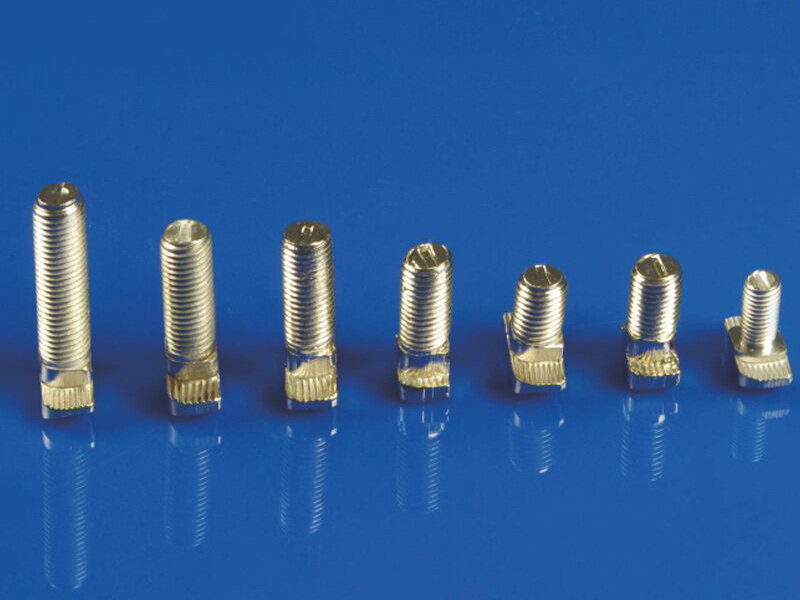 Aluminium Drop-in T Bolt for T-Slot ProfilesThis drop-in T bolt suits joints where the bolt head must sit inside the slot, offering fast assembly without sliding along the full length. Its lightweight aluminium build keeps frames stable while simplifying panel and bracket mounting.View Product →
Roll-In Nuts for Quick Lateral Assembly
Roll-in nuts are inserted from the side of the slot, making retrofits faster. Spring-ball and spring-leaf versions stay in position while you insert the bolt, which is a real time-saver when assembling complex frames. They are not always as strong as a fully engaged drop-in nut, so check the load rating for the specific profile series.
Flange Nuts for Panel and End Connections
A carbon steel flange nut with a serrated face locks onto the profile or a bracket surface and distributes clamping pressure over a wider area. It is a good choice when you are attaching panels, feet, or other hardware to the exterior of the slot.
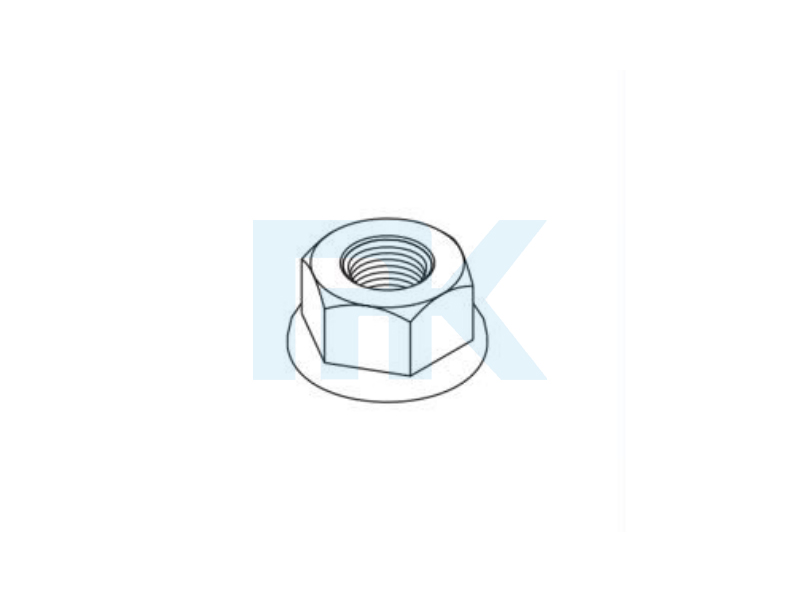 Aluminium Flange Nut with Wide Base for T-Slot JointsThe flange nut's wide base spreads clamping force evenly to reduce profile damage and resists corrosion, making it suitable for both indoor and outdoor framing. It is a practical pick for sturdy automation, fence, and display structures.View Product →
For simple sliding applications, a standard sliding nut is still the most economical option. It is easy to use, works with any slot depth, and is available in carbon steel with the same strength benefits as more complex designs.
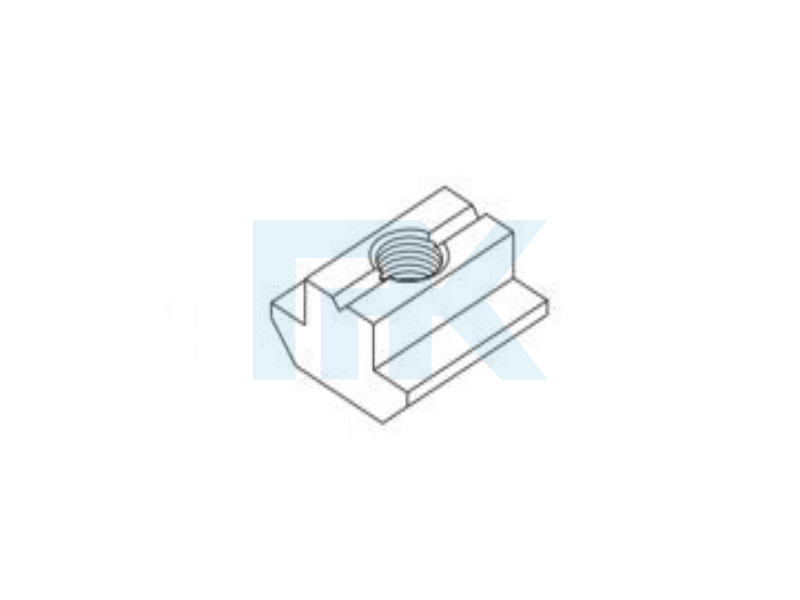 Aluminium Sliding Nut for Flexible T-Slot PositioningThis sliding nut moves smoothly along the T-slot channel, allowing quick repositioning of bolts and accessories without full frame disassembly. Its rust-resistant aluminium build suits machine guards, conveyors, and custom structures.View Product →
Load Capacity and Sizing: Match the Fastener to the Slot
A high-strength bolt does nothing if its head does not fit the slot correctly. Each aluminum profile series has a nominal slot width and a specific fastener size that maximizes pull-out resistance. For example, a 40-series slot usually works with M6 or M8 fasteners, while a 20-series slot may take M4 or M5. Using an oversized fastener will deform the slot, and an undersized one will cause play.
Carbon steel’s high stiffness means the fastener will not yield before the profile does. That shifts the failure mode to the aluminum edge, so the contact area and the shape of the T-nut matter as much as the bolt grade. A wider carbon steel T-nut spreads the load better than a small standard nut.
| Profile series | Slot width (mm) | Common fastener size | Recommended torque (Nm) |
|---|---|---|---|
| 20 series | 6.2 | M4 or M5 | 2-3 |
| 30 series | 8 | M5 or M6 | 5-8 |
| 40 series | 10 | M6 or M8 | 10-15 |
| 45 series | 10 | M6 or M8 | 10-15 |
| 80 series | 12 | M8 or M10 | 20-30 |
Those figures are starting points for standard aluminium profiles. Always refer to the profile manufacturer’s data sheet because wall thickness varies between heavy and light series.
Common Coatings for Carbon Steel T-Slot Fasteners
The coating determines how long the fastener stays reliable and how smooth it feels during assembly. Zinc plating is the default: it provides a good compromise for indoor machinery, but the layer is thin and can be scratched during installation. Nickel plating is harder and slightly more corrosion resistant, and it reduces wear when the fastener slides into the slot.
| Coating | Corrosion resistance | Appearance | Cost impact | Recommended environment |
|---|---|---|---|---|
| Zinc plating | Good (indoor) | Bright silver | Low | Dry factory floors, workshops |
| Nickel plating | Very good | Shiny silver | Medium | Humid or partially outdoor areas |
| Dacromet | Excellent | Grey matte | Medium-high | Outdoor racks, coastal areas |
| Black oxide | Poor | Black | Low | Optics, instruments (dry indoor) |
Do not judge a fastener by color alone. A bright zinc-plated finish on a low-quality part can peel after a few tightening cycles. Ask for coating thickness in microns, especially if your assembly will be disassembled and reassembled several times.
Installation and Corrosion Protection: What to Watch For
The first question buyers ask is whether carbon steel will rust when it touches aluminum. The short answer is: not quickly if it is plated, and not much if the joint is dry. Carbon steel and aluminum have different electrochemical potentials, but the galvanic effect is significant only when water bridges the two metals. In dry indoor applications, a zinc-plated carbon steel T-bolt will last for years without visible corrosion. Outdoors, add a layer of isolation, such as a nylon washer or a rubber seal between the steel and aluminum, or choose a Dacromet-coated fastener.
The second most common issue is over-tightening. Carbon steel threads can generate enough torque to crush or bend the aluminum slot. Use a torque wrench for critical joints, and respect the values shown in the table above. If you hear crackling, stop immediately; that is a warning that the T-nut may be bending the slot walls.
For frames that see vibration, add a spring washer or use a flange nut. Thread-locking fluid can replace the need for high torque and reduces the risk of stripping the aluminum thread. Also keep the T-slot clean: saw chips and dust prevent the T-nut from seating fully and create false torque readings.
- Clean the slot before inserting the nut. Dust and chips cause false torque readings.
- Fasten to the recommended torque. Over-tightening is the most common cause of slot deformation.
- Use thread-locking fluid on critical joints instead of adding torque.
How to Choose the Right Carbon Steel Fastener for Your Frame
Start with the load path. If the joint carries shear load, a drop-in T-bolt with a full shoulder is a safe bet. If it needs to be disassembled often, a roll-in spring nut saves time. For visible surfaces, a black-oxide coating is more cosmetically appealing, while zinc-plated parts are more corrosion resistant.
When ordering from a supplier, check three things: the fastener’s strength class, the coating thickness, and the actual slot-width dimension. Low-cost imports may use slightly thinner flanges that slip or deform, so ask for the same geometry as your profile manufacturer recommends. If your project includes heavy joints and long spans, this guide to carbon steel T-slot connectors explains how load paths behave in larger structures.
Sourcing carbon steel T-slot fasteners from an unknown supplier carries hidden risks. The most common are non-standard head heights and poor thread concentricity. Both produce loose joints that appear tight. Ask for a dimensional drawing and a batch test report before committing to a large order.
Finally, buy a few extra fasteners from the same batch. T-slot hardware is easy to lose inside a frame during assembly, and matching the same surface finish later can be difficult. A small surplus keeps the build consistent and avoids mixing fasteners of different strengths.
Carbon steel T-slot fasteners are not a special material, but they are the practical upgrade that turns an aluminum extrusion frame from a model-building toy into a load-bearing machine structure. Choose the right type, size, and coating, tighten with a torque wrench, and the frame will hold its geometry for years.
If you are sourcing for a production run, compare the actual dimensions and strength grade before ordering. That one step will save you more assembly time and callbacks than any other design decision.