English
 عربى
عربى BLDC
BLDC

Anyone who has watched a steel bracket rust through after a single wet winter understands why galvanized T slot connectors exist. They do the same job as bare or painted hardware, locking two aluminium profiles together at a fixed angle under load, but a zinc coating absorbs the moisture, salt, and chemical exposure that would otherwise attack the joint. In a modular framing system the profiles are aluminium and rarely corrode in normal service. The steel parts are the weak link, and that is precisely where galvanizing earns its place.
This guide covers what the coating really is, which connector families are worth specifying in galvanized steel, how to match them to the right fasteners, and how to install and maintain them so the joint still performs well years later.
Content
- 1 What Galvanizing Actually Does for a Steel Connector
- 2 Why Galvanized Connectors Matter in Modular Framing
- 3 Which Connector Families Are Available in Galvanized Steel
- 4 How to Choose the Right Galvanized Connector
- 5 Installation Practices That Protect the Coating
- 6 Fasteners Are Half of the Connection
- 7 Where Galvanized Connectors Earn Their Keep
- 8 Maintenance and Coating Repair
What Galvanizing Actually Does for a Steel Connector
Galvanizing is a zinc coating applied to steel, and the zinc works in two ways at once. It acts as a physical barrier that keeps moisture and oxygen away from the base metal, and it acts as a sacrificial anode: when the coating is scratched or cut, the surrounding zinc corrodes first and keeps protecting the steel underneath. That second behaviour is why a galvanized corner bracket survives a knocks-and-scrapes environment that would leave a painted bracket rusting from every chip.
Two production routes dominate the market:
- Hot-dip galvanizing. The finished part is immersed in molten zinc, producing a thick, metallurgically bonded coating usually measured in tens of microns, which handles outdoor and humid service well.
- Electro-galvanizing, or zinc plating. Zinc is deposited electrically, giving a thinner, smoother coating, often in the range of five to fifteen microns, which suits indoor frames and coated assemblies.
One clarification saves a lot of confusion during specification: in a T slot system the extruded profile is aluminium, so it is not galvanized. The parts that benefit from a zinc coating are the steel connectors, brackets, anchor fasteners, T nuts, and bolts that tie the frame together. When a supplier describes a galvanized T slot connector, that is what the term refers to.
Why Galvanized Connectors Matter in Modular Framing
Modular frames rarely live in a clean, dry workshop. They end up on loading docks, in wash-down areas, in cold rooms where condensation forms every night, on coastal sites, in greenhouses, and around livestock buildings. Each of those environments attacks steel in a slightly different way, and each one turns a plain, untreated bracket into a maintenance liability.
There is also the aluminium-to-steel interface to consider. Where a steel connector sits against an aluminium profile in the presence of moisture, the two metals can form a galvanic couple, and the aluminium becomes the more active metal. A zinc coating does not remove that effect completely, but it puts a sacrificial layer between the two, so the coating wears away instead of the profile. That is a considerably cheaper component to replace.
Which Connector Families Are Available in Galvanized Steel
Most T slot connector families can be supplied in a galvanized finish, though the material underneath varies. The table below summarises how the common families behave in damp or outdoor service.
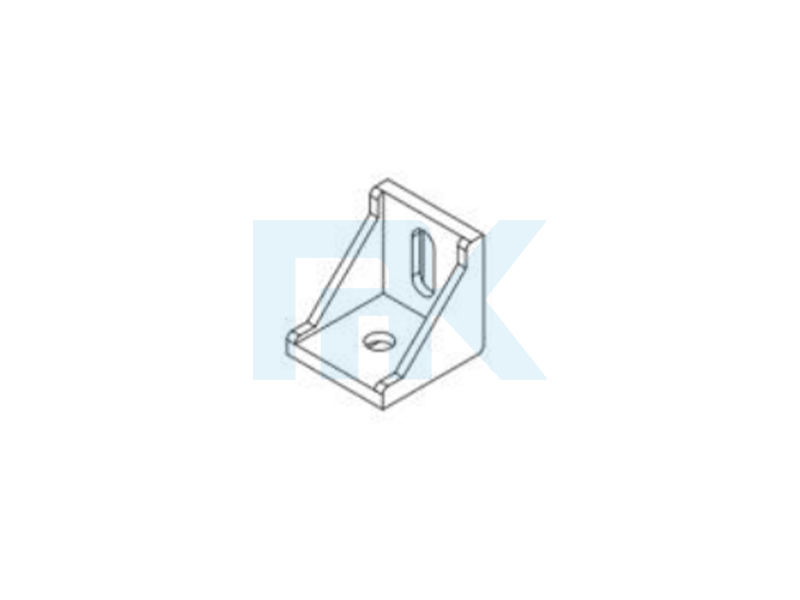 Die cast bracketCategory:T Slot ConnectorsView Product →
| Connector family | Typical material and finish | Usual application | Behaviour in wet service |
|---|---|---|---|
| External angle bracket, 45, 90 and 135 degree | Galvanized steel or die-cast zinc-aluminium | Right-angle joints and corner reinforcement | Good while the coating is intact; zinc-rich touch-up extends life |
| Die-cast corner gusset and reinforce bracket | Die-cast alloy, with galvanized steel versions for heavier duty | High-load corners, moving and vibrating frames | Good indoors and in sheltered outdoor positions |
| Anchor fastener, concealed type | Zinc-plated or galvanized steel | Clean, hidden 90 degree joints on visible frames | Moderate; specify a heavier coating for humid plants |
| Inner bracket and butt connector | Galvanized steel | Joining two profile ends in a straight line | Good; the joint sits inside the slot and stays protected |
| Central connector, cubic corner bracket and linear bar connector | Galvanized steel or die-cast alloy | Several profiles meeting at a single point | Good; inspect after any impact damage |
| Pivot hinge and swing hardware | Galvanized or plated steel | Doors, gates, hinged guards and access panels | Choose sealed or stainless pin versions for outdoor use |
How to Choose the Right Galvanized Connector
Selection is mostly a matter of matching the joint, the load, and the environment, in that order. Working through the following steps keeps the decision straightforward.
- Confirm the profile series and slot width. A 20 series profile takes different hardware than a 40 series or 45 series profile, and mixing them is the most common source of loose joints.
- Define the load path. Decide whether the joint mainly carries shear, tension, or a bending moment, and whether the load is static or repeated.
- Match the joint geometry. Right-angle corners, 45 degree miters, in-line extensions, and multi-way nodes each have a connector family designed for them.
- Read the environment honestly. Indoor shelving in a dry warehouse does not need the same coating as a wash-down station or an outdoor enclosure on a coastal site.
- Think about access after assembly. Concealed connectors give the cleanest appearance but are harder to re-tighten once the frame is closed in.
- Pair connector and fastener as one system, and follow the torque specification. Under-torqued joints slip, while over-torqued joints crush the slot or strip the thread.
Installation Practices That Protect the Coating
A galvanized joint lasts longer when the assembly process does not damage the very coating that protects it.
- Deburr and clean the slot before assembly so the connector seats flat against the profile face.
- Use washers where the design calls for them, since they spread the load and reduce coating damage at the contact point.
- Torque to the supplier's figure with a calibrated wrench rather than by feel.
- Avoid dragging brackets along the extrusion, which scrapes zinc off the contact surfaces.
- Re-check torque after the first few days of service, especially on frames that vibrate or see temperature swings.
Fasteners Are Half of the Connection
A galvanized bracket is only as good as the nut and bolt holding it. Sliding nuts, drop-in T nuts, flange nuts, and spring-leaf roll-in nuts each suit a different assembly method, and the coating on these small parts matters just as much as it does on the bracket. If you are still deciding between plated and galvanized hardware for a specific environment, our guide to choosing the right galvanized T slot fasteners walks through the trade-offs in more detail.
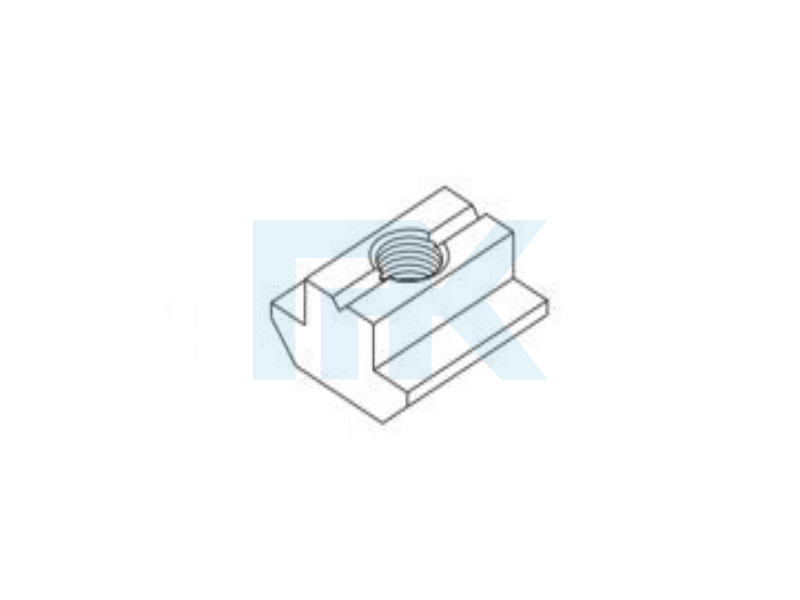 Aluminium Sliding Nut for Industrial T Slot Profile AssemblyCategory:T Slot FastenersView Product →
For concealed or high-load corners, an anchor fastener pulls the joint tight from inside the slot, leaving the outside of the frame clean. It is a popular choice for machine guards and display frames where the connector should not be visible.
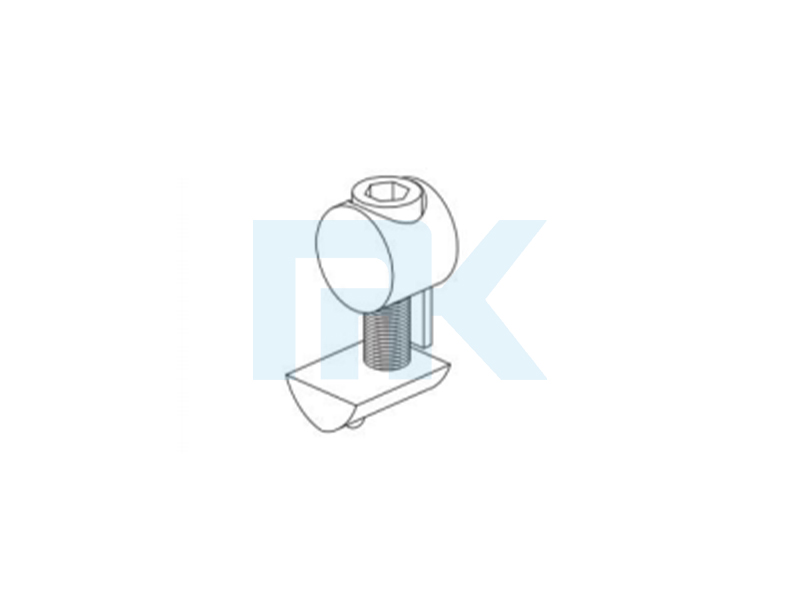 Anchor FastenerCategory:T Slot ConnectorsView Product →
Where Galvanized Connectors Earn Their Keep
Galvanized hardware is usually specified for frames that will see moisture on a regular basis:
- Wash-down workstations and equipment frames in food, beverage, and pharmaceutical plants.
- Outdoor machine enclosures, generator frames, and skid-mounted equipment.
- Greenhouses, livestock pens, and agricultural handling frames.
- Cold storage and freezer rooms, where condensation forms on every cycle.
- Coastal installations, where salt in the air accelerates steel corrosion.
- Solar mounting structures and outdoor racking that stay exposed year round.
In dry indoor applications, galvanizing is not essential. It is a reasonable insurance policy, but an anodized aluminium or die-cast connector will usually give a longer, cleaner service life at a comparable cost.
Maintenance and Coating Repair
Galvanized connectors need very little attention, which is part of their appeal. A periodic visual check is enough in most installations. Look for white or grey zinc corrosion product, which is normal, and for red-brown rust, which signals that the coating has been breached. Clean the area, remove loose material, and repair small damaged spots with a zinc-rich paint. If a connector has been deformed by impact, replace it rather than straightening it, because both the coating and the load path are compromised once the part has yielded.
Fasteners in outdoor frames deserve the same check. Stainless steel bolts paired with galvanized brackets are a common and sensible combination in aggressive environments, provided the two are isolated where the design requires it.
Galvanized T slot connectors are a small line item in most bills of materials, yet they decide how long a frame stays square, clean, and safe. Matching the coating to the environment, choosing the right connector family for the joint, and pairing everything with fasteners from the same slot standard is all it takes to build a structure that outlasts the equipment mounted on it.