English
 عربى
عربى BLDC
BLDC

Solar nuts are one of the most overlooked components in a photovoltaic installation, yet they are directly responsible for keeping your panels secured through decades of wind, rain, thermal cycling, and mechanical stress. Whether you're installing a rooftop residential array, a ground-mount commercial system, or a carport structure, the nuts you choose and how you install them determine whether your racking system stays tight for 25 years or starts to loosen and shift within a few seasons. This guide covers everything practical — what solar nuts are, which types are used in modern racking systems, material selection, torque requirements, and what goes wrong when installers cut corners.
Content
- 1 What Solar Nuts Are and Why They Matter
- 2 Types of Solar Nuts Used in Mounting Systems
- 3 Material Selection: Stainless Steel vs. Aluminum vs. Other Options
- 4 Torque Specifications for Solar Mounting Nuts
- 5 How Solar T-Slot Nuts Work in Rail-Based Racking Systems
- 6 Solar Nut Sizing: Matching the Right Nut to Your Racking System
- 7 Electrical Bonding and Grounding: The Role of Solar Nuts in System Safety
- 8 Common Problems Caused by Wrong or Poorly Installed Solar Nuts
- 9 Buying Solar Nuts: What to Check Before You Order
What Solar Nuts Are and Why They Matter
Solar nuts are threaded fastening components specifically selected or engineered for use in solar panel mounting and racking systems. The term covers a range of nut types — from standard hex nuts and flange nuts to specialized T-slot nuts, channel nuts, and spring-loaded positioning nuts that are integral to aluminum rail-based racking systems. They work in combination with bolts, carriage bolts, and machine screws to clamp module frames, mid-clamps, end-clamps, rail splices, and mounting feet together into a unified structural assembly.
The reason solar panel nuts deserve specific attention — rather than simply grabbing hardware from a general fastener bin — comes down to three factors: corrosion resistance, galvanic compatibility, and vibration resistance. A solar array is expected to perform for 25 to 30 years in an outdoor environment. Standard zinc-plated or uncoated carbon steel nuts will corrode rapidly in that exposure window, especially in coastal environments or regions with high humidity, freeze-thaw cycling, or acidic precipitation. Corroded fasteners seize, making future maintenance and panel replacement enormously difficult, and in severe cases, they lose structural integrity entirely.
Galvanic compatibility is equally critical. Most solar racking rails are made from anodized aluminum. Pairing aluminum with carbon steel fasteners creates a galvanic couple that accelerates corrosion of the less noble metal — in this case, the steel — dramatically shortening fastener life. This is why virtually all professional-grade solar mounting hardware specifies stainless steel or aluminum fasteners for use in aluminum racking systems.
Types of Solar Nuts Used in Mounting Systems
Modern solar racking systems use several distinct nut types, each serving a specific structural or installation function. Understanding what each type does helps you order the right hardware and install it correctly.
T-Slot Nuts (Channel Nuts)
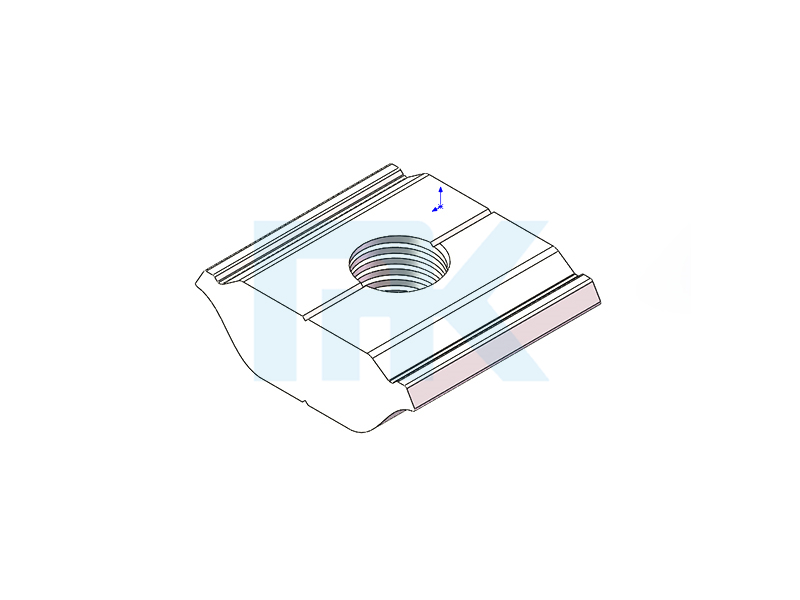
T-slot nuts, also called channel nuts or T-nuts, are the most commonly used solar panel mounting nuts in rail-based racking systems from manufacturers like Unirac, IronRidge, Schletter, and K2. They are designed to slide into the open T-shaped channel on the top face of the mounting rail, allowing mid-clamps, end-clamps, and bonding hardware to be positioned anywhere along the rail length before being locked in place by torqueing the bolt. This adjustability is essential for accommodating varying module frame widths, rail splice positions, and roof penetration spacings.
T-slot nuts for solar applications are typically made from stainless steel (most common) or anodized aluminum and come in two variants: standard sliding T-nuts that require the nut to be inserted from the end of the rail, and spring-loaded T-slot nuts that can be dropped into the channel slot from above at any point and rotate into the locked position when the bolt is tightened. Spring-loaded variants significantly speed up installation, particularly on long commercial arrays.
Hex Nuts and Nylon Insert Lock Nuts (Nyloc)
Standard hex nuts in M6, M8, M10, or 1/4"-20 and 5/16"-18 sizes are used throughout solar racking assemblies for connecting mounting feet to roof attachments, securing rail splices, and attaching ground lugs and bonding jumpers. In any position subject to vibration — particularly on metal roof systems or ground-mount systems exposed to wind-induced oscillation — nylon insert lock nuts (commonly called Nyloc nuts) are preferred because the nylon insert grips the bolt thread and resists loosening under vibration without requiring thread-locking compounds.
Flange Nuts
Flange nuts incorporate a wide, serrated or smooth circular flange at the base that distributes clamping load over a larger surface area. In solar mounting, serrated flange nuts are frequently used to establish electrical bonding between aluminum rail sections and mounting hardware, because the serrations bite into the anodized surface of the aluminum, cutting through the non-conductive oxide layer to create a metal-to-metal electrical contact. This function makes them a dual-purpose component: mechanical fastening and grounding/bonding.
Acorn Nuts and Cap Nuts
Acorn nuts (dome cap nuts) are used in solar installations primarily at exposed bolt ends on end-clamps and rail terminations where a protruding threaded bolt end would otherwise present an injury hazard to maintenance personnel or cause abrasion damage to roofing membranes. They also seal the bolt thread from direct moisture exposure, reducing the risk of thread corrosion at critical connection points.
Coupling Nuts (Hex Standoffs)
Coupling nuts, also known as hex standoffs or extension nuts, are long-form hex nuts used to join two threaded rods end-to-end or to extend a bolt thread. In solar installations, they appear in ballasted flat-roof racking systems and in adjustable leg assemblies for ground-mount structures where height adjustment is needed to level the array on uneven terrain.
Material Selection: Stainless Steel vs. Aluminum vs. Other Options
The material of your solar fastening nuts determines their long-term corrosion performance and their compatibility with the rest of the racking system. Here is a direct comparison of the materials most commonly specified for solar panel mounting nuts:
| Material | Corrosion Resistance | Galvanic Compatibility with Aluminum Rail | Typical Use |
| 304 Stainless Steel | Excellent (non-coastal) | Good — low galvanic risk with aluminum | Standard residential and commercial racking |
| 316 Stainless Steel | Superior (coastal/marine) | Good — low galvanic risk with aluminum | Coastal, marine, high-humidity environments |
| Anodized Aluminum | Good | Excellent — same metal, no galvanic coupling | Lightweight aluminum rail systems |
| Hot-Dip Galvanized Steel | Good (inland/rural) | Moderate — avoid direct contact with aluminum | Steel ground-mount structures |
| Zinc-Plated Carbon Steel | Poor (outdoor long-term) | Poor — accelerated corrosion with aluminum | Not recommended for permanent solar installations |
For most residential and light commercial rooftop solar systems using aluminum racking, 304 stainless steel solar panel nuts are the standard and appropriate choice. Projects within one mile of saltwater should upgrade to 316 stainless steel throughout. On steel ground-mount structures where all components are steel, hot-dip galvanized nuts are acceptable, but verify that the zinc coating thickness meets ASTM A153 Class C or D minimums for outdoor exposure.
Torque Specifications for Solar Mounting Nuts
Correct torque is one of the most frequently skipped steps in solar installation, yet it directly determines whether the mechanical and electrical integrity of the array is maintained over its service life. Under-torqued solar nuts allow clamps to shift under wind load, risk panel micro-cracking from movement, and create high-resistance electrical connections at bonding points. Over-torqued nuts strip aluminum threads in the rail, crack the anodized surface, and can fracture panel frame extrusions.
Torque specifications vary by fastener size, racking manufacturer, and connection type. Always follow the racking system manufacturer's installation manual as the authoritative source. The table below shows representative torque values for common solar mounting nut sizes:
| Fastener Size | Typical Application | Torque Range |
| M6 / 1/4"-20 | Mid-clamps, end-clamps, bonding hardware | 7–10 Nm (62–89 in-lb) |
| M8 / 5/16"-18 | Rail-to-foot connections, splice plates | 16–20 Nm (142–177 in-lb) |
| M10 / 3/8"-16 | Foot-to-flashing, ground-mount structure connections | 30–40 Nm (265–354 in-lb) |
| M12 / 1/2"-13 | Ground-mount post anchors, large structural connections | 60–80 Nm (531–708 in-lb) |
Use a calibrated torque wrench or torque screwdriver for all solar fastener connections — not an impact driver set to a "feel" approximation. Impact drivers are appropriate for running fasteners down quickly but should never be used as the final torque step on solar racking hardware. After the initial torque is applied, mark each nut with a torque stripe (a line drawn across the nut and bolt with a paint marker) so any subsequent rotation due to loosening is immediately visible during inspection.
How Solar T-Slot Nuts Work in Rail-Based Racking Systems
Because T-slot nuts are the most widely used solar mounting nuts and are often misunderstood by first-time installers, this section covers their mechanics and installation in detail.
Standard Sliding T-Slot Nut Installation
Standard T-slot nuts must be loaded into the rail channel from the open end of the rail before any end caps or rail stops are installed. They slide freely along the channel until a bolt is inserted from above through the clamp or hardware being attached, threaded into the T-nut, and torqued down. As the bolt is tightened, the T-nut's wings are pulled flush against the underside of the channel lips, locking the nut in position. The limitation of this type is that once the rail ends are closed or obstructed, no additional T-nuts can be added without disassembly.
Spring-Loaded T-Slot Nut Installation
Spring-loaded T-slot nuts — also called drop-in T-nuts or quarter-turn T-nuts — feature a spring that holds the nut body at a 45-degree angle, allowing it to be inserted through the narrow slot opening from above. Once inserted, the spring rotates the nut flat and the wings engage the underside of the channel lips. This design allows T-nuts to be added anywhere along an already-installed rail at any point during installation, making mid-installation layout adjustments far easier. On large commercial projects, the labor savings from using spring-loaded channel nuts instead of standard sliding T-nuts are significant.
Verifying T-Nut Engagement Before Final Torque
Before applying final torque to any T-slot nut connection, verify that the nut is fully engaged by gently attempting to slide the hardware along the rail while holding light hand pressure on the bolt. If the hardware slides freely, the nut is not engaged — it may be misaligned, upside down, or sitting on top of the channel lip rather than below it. An unengaged T-nut will appear to torque correctly but will pull out under load. This failure mode is responsible for a meaningful proportion of solar array structural failures during high-wind events.
Solar Nut Sizing: Matching the Right Nut to Your Racking System
Solar panel mounting nuts must match both the thread specification of the bolt and the slot dimensions of the rail channel. Mixing metric and imperial thread fasteners — a common error when mixing hardware from different suppliers — produces connections that appear assembled but have minimal thread engagement and will fail under load.
- Thread pitch must match the bolt exactly. An M8 x 1.25 bolt requires an M8 x 1.25 nut — not an M8 x 1.0 fine-pitch nut. Cross-threading is possible when pitch is mismatched, resulting in false torque readings and negligible clamping force.
- T-slot nut body dimensions must match the rail channel profile. Different racking manufacturers use different channel widths and depths. A T-nut sized for an IronRidge XR10 rail will not correctly fit a Unirac SolarMount rail. Always source T-slot nuts from the racking system manufacturer or a verified compatible aftermarket supplier.
- Nut height matters in thin-section applications. In applications where clearance between the nut and the inside of a channel is tight, oversized nut body height can prevent full engagement of the nut wings, reducing pull-out strength.
- Washer use should follow manufacturer guidance. Some racking systems specify flat washers under the nut to distribute load; others are designed to be used without. Adding washers not specified in the installation manual can alter the clamping geometry and reduce effective clamping force on the module frame.
Electrical Bonding and Grounding: The Role of Solar Nuts in System Safety
In addition to their mechanical function, solar panel mounting nuts play a direct role in the electrical safety of a photovoltaic system. NEC Article 690 and IEC 62548 require that all exposed metal parts of a PV array — including module frames, racking rails, and mounting structures — be bonded together and connected to a grounding electrode system. This equipotential bonding prevents dangerous voltage differences between conductive surfaces in the event of a ground fault.
Several methods of achieving this bonding rely directly on the solar nuts and hardware at each connection point. Serrated flange nuts, bonding washers (such as Wiley Electronics WEEB washers), and listed bonding mid-clamps all use the mechanical force of the fastener to penetrate the anodized layer on aluminum components and establish a low-resistance metal-to-metal electrical path. If these fasteners are under-torqued, the serrations or bonding teeth do not fully penetrate the oxide layer, and the bonding connection has excessively high resistance — which may not be caught during a standard continuity test but can fail to carry fault current safely during an actual ground fault event.
When installing solar nuts used for bonding purposes, confirm that the correct torque is applied and that the contact surfaces are free of dirt, moisture, and excessive oxidation before assembly. In retrofit or maintenance situations where bonding hardware has been removed and reinstalled, use new serrated nuts rather than reusing the originals — the serration teeth deform during the first installation and will not penetrate the oxide layer as effectively on reinstallation.
Common Problems Caused by Wrong or Poorly Installed Solar Nuts
Field inspections of solar arrays — particularly those installed during the rapid growth of the industry in the 2010s — consistently reveal fastener-related problems that compromise structural integrity, electrical safety, and long-term system performance. These are the most frequently documented issues:
- Corroded or seized fasteners: Carbon steel or zinc-plated nuts corrode and seize to bolts within five to ten years in outdoor environments, making panel removal for maintenance or replacement extremely difficult and damaging the racking hardware in the process.
- Loose mid-clamps and shifting panels: Under-torqued T-slot nuts allow mid-clamps to slide under repeated wind loading, causing panels to shift out of their designed position, increasing stress on wiring and connectors, and in severe cases allowing panels to partially lift off the mounting system.
- Stripped rail threads: Over-torquing nuts in aluminum rail channels strips the thread form in the aluminum, reducing pull-out resistance to near zero. This damage is not visible from outside and may go undetected until a high-wind event.
- Failed grounding continuity: Bonding hardware installed with incorrect nuts or insufficient torque fails to establish proper electrical continuity across the array, creating a code violation and a genuine safety hazard that is difficult to detect without specialized low-resistance testing equipment.
- Galvanic corrosion at mixed-metal interfaces: Using carbon steel or zinc-plated nuts against aluminum racking creates white powdery corrosion (aluminum oxide) and red rust contamination that weakens both the fastener and the rail at the contact point over time.
Buying Solar Nuts: What to Check Before You Order
When sourcing solar panel nuts and hardware for a new installation or a maintenance project, use this checklist to ensure you're ordering the right product:
- Confirm the racking system brand and rail profile: T-slot nuts are rail-specific. Identify your rail manufacturer and model before ordering. Using a universal or "compatible" T-nut from a third party without verifying dimensional specs against the rail channel drawing is a common source of fitment problems.
- Verify thread size and pitch: Check whether your racking system uses metric (M6, M8, M10) or imperial (1/4"-20, 5/16"-18, 3/8"-16) fasteners. Most North American residential racking uses imperial; many European and some commercial systems use metric.
- Specify material grade: For aluminum racking, order 304 or 316 stainless steel. Request a material certification or at minimum confirm the grade on the product listing. Generic "stainless" hardware from unverified sources is sometimes 200-series stainless, which has significantly lower corrosion resistance than 304 or 316.
- Check whether hardware kits are included with clamps: Many racking manufacturers supply mid-clamps and end-clamps with T-slot nuts and bolts included. Ordering additional loose nuts for these components creates a risk of mixing incompatible hardware. Count what's included in your clamp kit before ordering supplemental fasteners.
- Order a surplus of 10–15%: Small fastener components are easily dropped on rooftops or misplaced during installation. Having a buffer quantity prevents project delays caused by a shortage of a specific nut size on the day of installation.